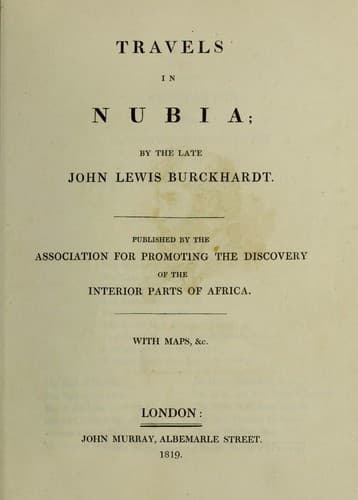
Burckhardt, John Lewis, 1784-1817; Nile River Valley -- Description and travel; Nubia -- Description and travel
[Footnote 31: There is no _village_ bearing the name of Sukkot;
it is a mere territorial appellation.]
[Footnote 32: The few Nubians who know how to write, and who serve
the governors in the capacity of secretaries, are taught by the
Fokara of Damer, south of Goos, (vide Bruce’s Map), who are all
learned men, and travel occasionally to Cairo as already mentioned,
to visit the mosque El Azhar. On their way thither they alight at
the houses of the rich inhabitants, and teach their children to read
and write. Many of the children of Sukkot and Mahass are likewise
sent to the school of the Arabs Sheygya, where they remain for ten
years and upwards, and are fed and taught gratuitously by the Olema
of that tribe.]
[Footnote 33: See p. 39.]
[Footnote 34: M. Rosetti has, for many years, had the trade in
Senna exclusively in his own hands; and has factors at Esne and
Assouan. Since Mohammed Aly has farmed out almost all the articles
of commerce, both foreign and domestic, M. Rosetti has paid for
the monopoly of Senna 150 purses per annum, or about £3,500.]
[Footnote 35: I have already observed, that the water of the wells in
Upper Egypt is of the worst kind, although dug in the neighbourhood
of the river, from which the wells are no doubt supplied, by the
water filtrating through the ground after the inundation, and
collecting at a depth of from twenty to thirty feet. See p. 22, 3.]
[Footnote 36: In the mountains east of the Dead Sea are Bedouins
called Beni Hamyde.]
[Footnote 37: See p. 29.]
[Footnote 38: The Mhoury is a measure corresponding with twelve
Mouds of Cairo, or about eight bushels.]
[Footnote 39: The whips known in the East under the name of Korbadj,
are made of the skin of the hippopotamus, and form an article of
commerce with the Sennaar and Darfour caravans.]
[Footnote 40: I found the reports of distances to be very
contradictory; the only mode of reckoning is by days journeys;
but the daily rate of camels, when not travelling in caravans,
is subject to great variation.]
[Footnote 41: Merawe is seven days journeys distant from Demar
(vide Bruce’s Map). Between Merawe and Bruce’s Goos lies the
country of Mograt مُقراط, whose chief, Naym, is a robber;
he often attacks the caravans which travel from Goos to Egypt, if
their numbers are not sufficient to overawe him. Mograt is three days
journeys from Goos. This latter name is not known to the Africans
of those parts which I visited; but they are well acquainted with
the county called Berber, which lies one day’s journey north of
Demar, and therefore corresponds with Bruce’s Goos. The caravans
from Berber arrive, at present, almost every month in Upper Egypt.]
[Footnote 42: See p. 21.]
[Footnote 43: I saw this chief at Siout, a naked black, without
the smallest sign of royalty about him.]
Public-domain text, read in full here on John Shaqi.
Reviews
Reviews
No reviews yet
Be the first to share your thoughts on this work.
Elsewhere in the archive
Join the Discussion
Join the discussion
Sign in to leave a comment or review.
Sign InorCreate an account