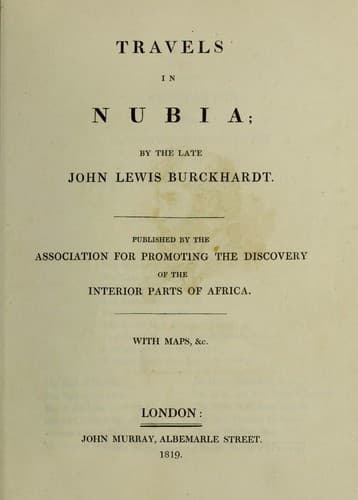
Burckhardt, John Lewis, 1784-1817; Nile River Valley -- Description and travel; Nubia -- Description and travel
_4th. March._ Our route this morning lay through sandy valleys
until we arrived, after about four hours march, at a steep ascent,
or Akaba, where the sand and flint hills terminate. After crossing
over the Akaba which is composed of granite schistus, we arrived,
at the end of six hours, at a fine natural reservoir of rain water,
among the granite rocks called Abou Adjadj (ابو عجاج);
our route was in a S. S. W. direction. From hence to Assouan the
distance is six hours. Just beyond the bason of rain water, begins
a narrow pass among the rocks, where loaded camels proceed with
difficulty. In here turning round a corner of the mountain we found
our advanced men, loudly quarreling with a strong party of armed
Bedouins, and before I could inform myself of the particulars,
the Ababde belonging to our caravan had armed themselves, and
proceeded to attack the enemy. The latter were likewise Ababde,
but of a different tribe. Having been informed of our departure
from Daraou, they had left their homes at Khattar (خطّار),
a village near Assouan, to way-lay us in this narrow pass, and
to levy a contribution upon us as passage money. They were about
thirty, and our Ababdes as many. The individuals of both parties
were naked, for it is a rule among them never to fight with any
incumbrance upon their bodies, and merely to wrap a rag or napkin
round their waists.[2] They were armed with long two-edged swords,
and short lances and targets, which latter were particularly
useful to them in warding off the shower of stones with which the
attack commenced. When I saw them thus attack each other, and then
under the most horrible clamour come to close action with swords
believing that we were attacked by robbers, I was about to join
our people, and had already levelled my musquet at the principal
man of the assailants, when one of our Ababdes cried out to me,
for God’s sake not to fire, as he hoped there should be no blood
between them. By the advice of our guides, the Egyptian merchants,
who were armed with swords, (for nobody had a gun but myself,
and few had pistols) willingly took charge of the defence of our
baggage in the rear, for the Ababde were anxious to fight out the
quarrel amongst themselves. After about twenty minutes’ rather
shy fighting, the battle ceased by the interference of the chiefs on
both sides, and both parties claimed the victory. The whole damage
amounted to three men slightly wounded and one shield cleft in
two. Our people however gained their point, for we passed without
paying any tribute, and I was somewhat gratified in seeing how far
our Arabs might be depended upon in any future attack in the course
of the journey. As for the Egyptians they had given evident proofs
of the most cowardly disposition, notwithstanding their boasting
language. Several Shikhs of the Ababde have a right to claim a
tribute from the caravan. Others set up unfounded pretensions of
the same kind, and it is the duty of the guides (Khobara plur. of
Public-domain text, read in full here on John Shaqi.
Reviews
Reviews
No reviews yet
Be the first to share your thoughts on this work.
Elsewhere in the archive
Join the Discussion
Join the discussion
Sign in to leave a comment or review.
Sign InorCreate an account