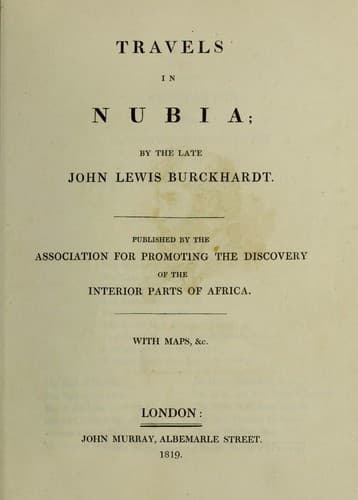
Burckhardt, John Lewis, 1784-1817; Nile River Valley -- Description and travel; Nubia -- Description and travel
the chief of the Ababde was the acknowledged head of the caravan,
yet the Fellah merchants generally followed their own humour in
moving and halting;[3] and there was every evening some quarrelling
about the place of halting. None of the traders had any tent;
we all slept in the open air, but none ever shut his eyes without
placing his baggage in such a manner as to render it difficult for
thieves to attempt it without awaking him. We were not afraid of
robbers from without, but it was too well known that many of our
own people were of a pilfering disposition, and notwithstanding
every precaution, they repeatedly indulged themselves in it in the
course of the journey.
_6th March._ We continued in Wady el Hebal for about three hours,
when we stopped near an inlet in the western chain of hills, where
we found among the rocks a large natural reservoir of rain water,
delightfully clear, sweet, and cool. The place is called Damhit
(دمحيت), and is much praised by the Arabs, because the water
is very seldom dried up. It is situated in a cleft of the mountain,
which has the appearance of having been rent asunder by a violent
earthquake. Large blocks of granite are heaped up at the entrance;
these masses increase in quantity, in ascending through the
cliff, and rise to a considerable height, among them are two other
reservoirs of water of equal size with the lower, but of difficult
access. The Wady itself is not without its natural beauties. It is
about forty yards across, overgrown with acacia or (سنط) _Sant_
trees, and bordered on both sides by steep shattered granite cliffs,
of grotesque shapes. During heavy rains, which often happen here,
the water descending from the western chain collects in a large
torrent, which, as I was informed, empties itself into the Nile,
near the village of Dehmyt, eight hours south of Assouan. About
four hours distant from Damhit, in a S. W. direction, is a spring of
good water called El Moeleh (الموِيلَح); it is resorted to
by the caravans, which set out from Assouan. We remained here the
whole day, for it is a general rule among caravans in the east,
to make slow marches during the three or four first days of a
long journey, in order to accustom the cattle, which are generally
allowed several months of rest before the journey, to fatigue by
degrees; and this is particularly the case when the ground affords
good pasturage. Loss of time is seldom taken into consideration by
eastern merchants, and least of all by Arabs, and thus I have heard
it related at Damascus that the caravans from thence to Bagdad are,
in the spring, sometimes three months in crossing the desert. We
again met great numbers of locusts. These rapacious insects had
spread sometimes in such quantities over the mountain as to eat up
every green vegetable: the cattle of the Bedouins are some times
reduced by these animals to the greatest distress.
Public-domain text, read in full here on John Shaqi.
Reviews
Reviews
No reviews yet
Be the first to share your thoughts on this work.
Elsewhere in the archive
Join the Discussion
Join the discussion
Sign in to leave a comment or review.
Sign InorCreate an account