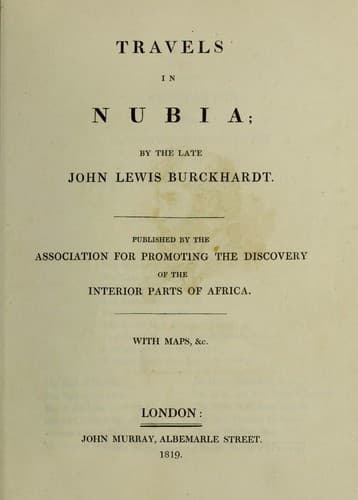
Burckhardt, John Lewis, 1784-1817; Nile River Valley -- Description and travel; Nubia -- Description and travel
_7th March._ After two hours we issued from the Wady and met several
Bisharein Arabs. These Bedouins, whom I have already mentioned in
my journey towards Dóngola, remain in winter time in the mountains
near the Red Sea, where the rains produce plenty of pasture; but
there being very few wells and springs in that quarter, they are
obliged to approach in summer nearer to the Nile, where wells are
more numerous. We were now upon an open sandy plain, without any
vegetation, bordered on the east by high mountains, and towards
the west, at a shorter distance, by lower hills. The whole valley
of Om el Hebal is of granite, but here in the plain I again found
sandstone with quartz. We were about five hours in crossing this
plain, which bears the name of Birket Zokhan (بركت زُخان),
and then after seven hours slow march (in the direction S. 1°
½ E.) we stopped at the entrance of a chain of low mountains,
where we found very luxuriant pasture. The herb called Towyle
(طويله) grows here in abundance, and is an excellent food
for the camels. From my first setting out from Daraou, I had been
involved in continual disputes with the man, to whom I had sold my
camel, and who carried my baggage. He had undertaken to take more
baggage than the camel was able to bear, and in order to lighten
it, he was constantly endeavouring to transfer my baggage, for the
carriage of which I paid him, to my ass. This evening the camel broke
down, when he accused me of having cheated him, in selling him an
unsound animal, insisting at the same time upon having his money
returned, a demand which was however soon over-ruled. According to
justice, and to the customs even of the traders themselves, he would
have been obliged to pay the further freight of my baggage out of
his own pocket; but he was so loud in his oaths and lamentations,
exclaiming that he was a ruined man, and besmearing his face with
dirt and dust, in sign of excessive grief, that he brought the
chiefs of the caravan all over to his side, and I was obliged to
contract a second time for the freight of my goods and provisions,
with one of the Bedouins Ababde. As we had already been six days
on our journey, our provisions were considerably diminished, and
the camel’s load became every day lighter. Upon this the traders
always reckon, never taking any spare camels from Egypt with them,
as other desert caravans usually do, and if camels break down,
their loads are distributed among the others, and the carriage is
paid for according to a fair calculation. No man can ever refuse to
charge his camel with part of such load, if necessity demands it,
and his own camel is strong enough. We again set out after sunset,
and marched about three hours farther, through several vallies,
until we came to the low mountains called Om Hereyzel (اُم
حُريذَل), where we stopped.
Public-domain text, read in full here on John Shaqi.
Reviews
Reviews
No reviews yet
Be the first to share your thoughts on this work.
Elsewhere in the archive
Join the Discussion
Join the discussion
Sign in to leave a comment or review.
Sign InorCreate an account