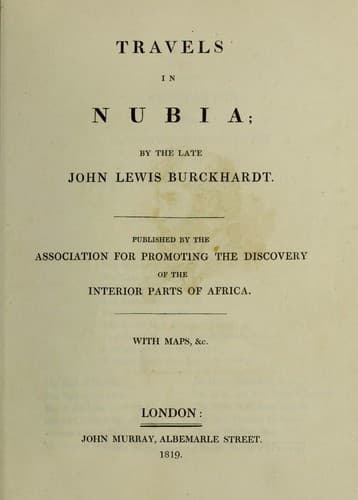
Burckhardt, John Lewis, 1784-1817; Nile River Valley -- Description and travel; Nubia -- Description and travel
slaughtering the cattle of the Bedouins, and taking liberties with
their women. Some such instances may have happened, but they were
certainly not sufficient to exculpate the Ababde, whose treacherous
character is too well known. The wells of Haimar are formed in a
small sandy plain, in the midst of craggy hills. In one or two of
them the water is drinkable, but in the greater part, it is of a
bitterish and very disagreeable taste, though in great plenty. A
nitrous crust is seen on the borders of the wells: the ground around
them was still covered with the dung of camels and horses which had
remained there since the time of the Mamelouk encampment. Old boots
and shoes, with rags of tents and clothing covered the ground. The
plain of Haimar is often frequented by large encampments of Bisharein
Bedouins, who pasture here their cattle, but as the wells are within
the dominion of the Ababde, they are obliged to pay a certain yearly
tribute to the Ababde chiefs. This is often the cause of wars, but at
present the Ababde have become more formidable than the Bisharein,
and their intercourse with Egypt renders them much the wealthier of
the two. It is only the northern Bisharein, who ever come in contact
with the Ababde. We found only a few families of Bisharein encamped
at Haimar, and passed through the plain without stopping, having
filled our water skins with the comparatively sweet water of the
Nakeyb. Beyond Haimar begins a wild, stony district, through which
our camels had difficulty in passing. We ascended amidst granite and
sand-stone rocks, for about one hour, and then descended again into
the plain, about five hours and a half after our setting out in the
morning. Our direction was S. 1° E. The mountains we passed are
called Akabet Haimar (عَقَبِة حيمَِر) and are visible
at a considerable distance. The plain beyond the Akabe is sandy,
with many insulated granite rocks. I could see no where any regular
strata, but the rocks were all in shattered, sharp-edged masses,
bearing the marks of some violent commotion of the earth. In one hour
we entered a fine valley called Wady Nehdyr, or Ghedeyr (the Arabic
name in my journal is not quite clear (غَدير or نَحدير),
with plenty of acacia trees. We had hoped to find some rain water
here, in a large basin formed by nature, but it was dry, and the
quantity of camel’s dung round it, proved that it had lately been
exhausted by an Arab encampment. We therefore rode on, and alighted,
after eight hours and a half, at the extremity of the Wady.
Public-domain text, read in full here on John Shaqi.
Reviews
Reviews
No reviews yet
Be the first to share your thoughts on this work.
Elsewhere in the archive
Join the Discussion
Join the discussion
Sign in to leave a comment or review.
Sign InorCreate an account