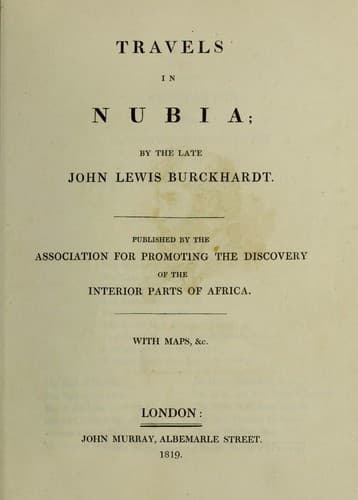
Burckhardt, John Lewis, 1784-1817; Nile River Valley -- Description and travel; Nubia -- Description and travel
_11th March._ Our road lay over stony hills and rocky passages,
for three hours, to the well called el Morra (المُرَّهَ),
meaning “the bitter,” a name which it justly bears when compared
to the sweet waters of the Nile; but the eastern Arabs, who are more
accustomed to bad water than Nubians and Egyptians, would hardly
perceive its disagreeable taste. It is a very large well, upwards
of forty feet in depth, and I was told that it never dries up. Wady
Morra extends for two or three hours, in an eastern direction. Having
here taken in a small provision of water, we immediately continued
our road, for five hours, to Wady Olaky (وادي عُلاقي) a
fine valley extending from east to west, and having its extremities
(as I was told) on one side near the Red Sea, and on the other near
the Nile. In time of rain considerable torrents collect in the Wady,
and empty themselves into the Nile. There is excellent pasturage
and many trees in the valley, for which rare advantages it is held
by the Bedouins in great veneration. Our guides in approaching the
Wady saluted it with great solemnity, and thanked heaven for having
permitted them to arrive so far in safety (السلاُم عليك
يا وادي علاقي الحمد لَّله الذي جيناك
بالسلامه). In crossing the valley, which is about one hundred
and fifty yards across, each person took a handful of Dhourra and
threw it on the ground, a kind of pious offering to the good genius
who is supposed to preside over the Wady. At the end of six hours
we entered Wady Om-gat (اُم قاط). It has a reservoir of rain
water, which renders it a resting place for caravans; but we found
it dry. No valley we had hitherto passed was so thickly overgrown
with acacia trees. Swarms of locusts were feeding upon the young
sprigs and leaves. The ground was covered with the coloquintida,
a plant very common in every part of this desert. The people of
the caravan amused themselves with throwing these round gourds at
each other, and warding them off with their targets, in which they
shewed great dexterity. Unfortunately I had no target, and my Daraou
_friends_ so often aimed at my head, that I was at last obliged
to apply seriously to the chief of the caravan for protection,
a measure which saved me from a bloody nose, but procured for me
the title of a “cowardly boy,” which lasted for several days,
until it was exchanged for an appellation still more insulting. Our
direction was this day S. by W. The ground of the Wady Omgat is all
sandy; the hills lose their wild, grotesque shape, and are disposed
in more regular chains. Most of the trees were entirely dried up,
there having been no rain for nearly three years. I was surprised not
to see the footsteps of any wild animals in the sand, and no birds,
except a few crows. We met several Bisharein, accompanying camels
loaded with Senna-mekke, which they were carrying to Derr for sale,
or to barter for Dhourra. We continued the whole evening in the Wady,
and halted after about nine hour’s march.
Public-domain text, read in full here on John Shaqi.
Reviews
Reviews
No reviews yet
Be the first to share your thoughts on this work.
Elsewhere in the archive
Join the Discussion
Join the discussion
Sign in to leave a comment or review.
Sign InorCreate an account