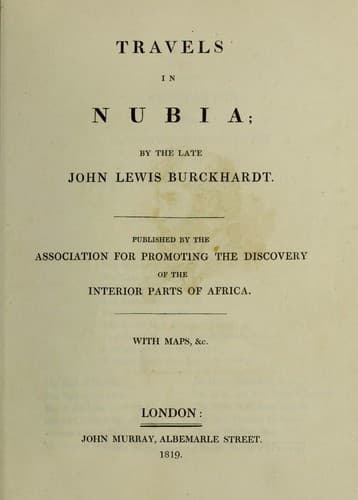
Burckhardt, John Lewis, 1784-1817; Nile River Valley -- Description and travel; Nubia -- Description and travel
_17th March._ We set out at daylight and approached the high
mountains of Shigre, which we had had in view the whole of the
preceding day. After two hours march, we entered among these
mountains, and then turning east, came to a fine Wady full of Doum
trees, and bordered on either side by steep, and almost inaccessible
cliffs. In following the windings of the valley, we arrived, after
four hours march, near the water of Shigre, (شِقر) where we
encamped. The surrounding mountains are all of granite, and consist
of blocks of various sizes, heaped upon one another in the wildest
disorder. Near the opening of the mountain, where the water is found,
at some distance below the highest summit, I found the rock to be
porphyry of a light reddish colour, close grained, with small veins
of feldspath, much resembling the porphyry I saw last year, in Wady
Lamoule, beyond the Second Cataract of the Nile. The approach to
the spring is somewhat difficult, being at the extremity of a very
narrow passage, in a cavern or cleft of the rock, where, besides
the spring, there is also a collection of rain water. The water
is excellent, and very cool, but unfortunately not very copious;
at least, we found only a small supply. Some pigeons were flying
about the spring. The well of Shigre is famous throughout this
desert. The Bisharein frequently encamp in the neighbouring Wadys,
and one of their principal Shikhs or Saints is buried near the
well. Travellers often make pious offerings at the tomb, and if
any Bedouins happen to be encamped in the neighbourhood, some sheep
are purchased from them, and killed in honour of the Saint. One of
our party found behind a rock, near the tomb, an empty chest, of
Egyptian workmanship, quite new, which had probably been deposited
there by some trader, whose camel could not carry it further,
and who expected to take it up again on his return. The Ababde
guides claimed it of the person who found it, alleging that they
are the masters of the desert, and that all treasures found in it
belong to them. We encamped at about half a mile from the well,
and our first care was to fill our water skins. The Ababde kindly
permitted the Fellah traders to fill their skins first, but the
latter abused the permission, by watering likewise their camels;
so that after they had retired from the well, very little water was
left in it. The Ababde then declared that they should be obliged to
stop here until the well should fill again. We remained therefore
the whole night, the Ababde sleeping at the mouth of the cavern,
to prevent any body from stealing water during the night.
Public-domain text, read in full here on John Shaqi.
Reviews
Reviews
No reviews yet
Be the first to share your thoughts on this work.
Elsewhere in the archive
Join the Discussion
Join the discussion
Sign in to leave a comment or review.
Sign InorCreate an account