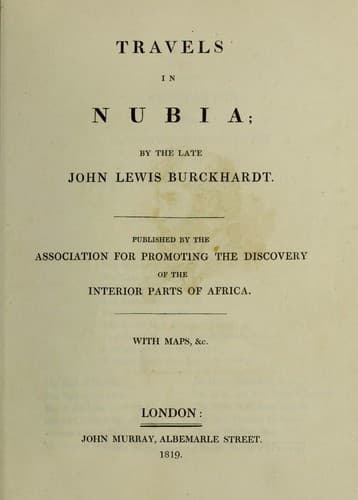
Burckhardt, John Lewis, 1784-1817; Nile River Valley -- Description and travel; Nubia -- Description and travel
_19th March._ Our road was S. by W. over an immense plain, bordered
by low hills in the distant horizon. After about one hour we passed
Wady Dimoka-yb (a Bishary name) (وادي ديموكايب), full of
dry shrubs. The day was intensely hot. I thought I could perceive
a considerable alteration in the climate, to the south of Shigre,
it being much warmer than to the north of that place. Eight hours
and a half passed Wady Abou Daey (وادي ابو ضَيّ). All
these Wadys extend from east to west. Eleven hours arrived at the
wells of Nedjeym (ابيار النجيم); in approaching which,
we passed, long after sunset, by several tomb-stones, called Gobour
Adjouad el Arey-ab (قبور اجوَد الاريَاب); “the
bravest men of Are-ab lie buried here,” said one of our chiefs;
“their companions carry them from many days journies to this
spot, that they may repose in the cool neighbourhood of the wells,
and their deeds be remembered by those who pass here.” The Are-ab
are a tribe of Bisharein. We had already sent some men to the wells
early in the morning, to clear them of the sand, for notwithstanding
the report of the caravan travellers which we received at Nabeh, our
people still believed that some water might be procured here. But we
found them sitting with melancholy countenances near the well, where
they had been digging for several hours, without finding any thing
but wet sand. Even the Bedouins now became alarmed, and nothing was
left for us but to endeavour to reach the Nile by forced marches;
each of us had some water left, though not more than sufficient
for a single day. Nedjeym is a collection of three or four wells,
where the water oozes from the ground, and collects in sand pits of
twenty or thirty feet in depth. The winds often choak these pits with
sand, and almost every caravan that passes must be at the trouble
of digging them out. We only found one accessible, the others being
filled with sand to the brim. In times of dryness, such as occurred
this year, the wells are exhausted, but when the rains are not
deficient they produce excellent water, in sufficient quantity to
supply a caravan of middling size. The low insulated rocky hills
which surround the Nedjeym are composed of chlorite and petrosilex.
Public-domain text, read in full here on John Shaqi.
Reviews
Reviews
No reviews yet
Be the first to share your thoughts on this work.
Elsewhere in the archive
Join the Discussion
Join the discussion
Sign in to leave a comment or review.
Sign InorCreate an account