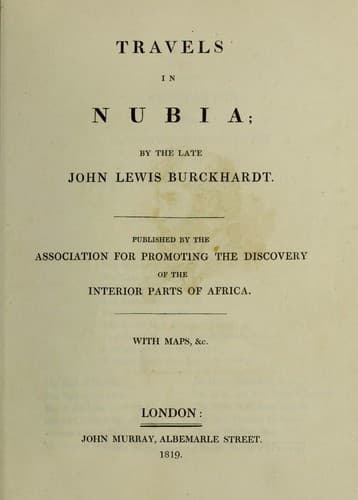
Burckhardt, John Lewis, 1784-1817; Nile River Valley -- Description and travel; Nubia -- Description and travel
They resolved therefore to direct their course
towards the setting sun, hoping thus to reach the Nile. After two
days thirst, fifteen slaves and one of the merchants died. Another
of them, an Ababde, who had ten camels with him, thinking that the
camels might know better than their masters where water was to be
found, desired his comrades to tie him fast upon the saddle of his
strongest camel, that he might not fall down from weakness; and thus
he parted from them, permitting his camels to take their own way:
but neither the man nor his camels were ever heard of afterwards. On
the eighth day after leaving Owareyk, the survivors came in sight
of the mountains of Shigre, which they immediately recognized,
but their strength was quite exhausted, and neither men nor beasts
were able to move any further. Lying down under a rock, they sent
two of their servants with the two strongest remaining camels,
in search of water. Before these two men could reach the mountain,
one of them dropped off his camel, deprived of speech, and able
only to wave his hands to his comrade as a signal that he desired
to be left to his fate. The survivor then continued his route,
but such was the effect of thirst upon him, that his eyes grew dim
and he lost the road, though he had often travelled over it before,
and had been perfectly acquainted with it. Having wandered about
for a long time, he alighted under the shade of a tree, and tied the
camel to one of its branches; the beast however smelt the water, (as
the Arabs express it,) and wearied as it was, broke its halter, and
set off gallopping furiously in the direction of the spring, which
as it afterwards appeared, was at half an hour’s distance. The
man well understanding the camel’s action, endeavoured to follow
its footsteps, but could only move a few yards; he fell exhausted
on the ground, and was about to breathe his last, when Providence
led that way from a neighbouring encampment a Bisharye Bedouin,
who by throwing water upon the man’s face restored him to his
senses. They then went hastily together to the water, filled the
skins, and returning to the caravan, had the good fortune to find
the sufferers still alive. The Bisharye received a slave for his
trouble. My informer, a native of Yembo in Arabia, was the man
whose camel discovered the spring, and he added the remarkable
circumstance that the youngest slaves bore the thirst better than
the rest, and that while the grown up boys all died, the children
reached Egypt in safety.
Public-domain text, read in full here on John Shaqi.
Reviews
Reviews
No reviews yet
Be the first to share your thoughts on this work.
Elsewhere in the archive
Join the Discussion
Join the discussion
Sign in to leave a comment or review.
Sign InorCreate an account