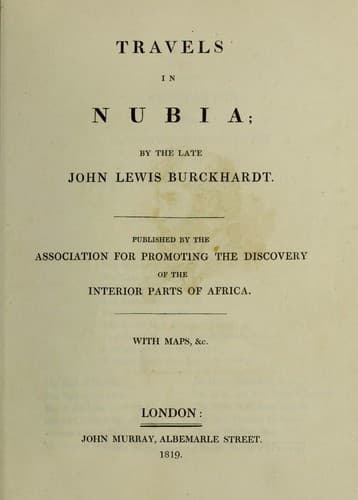
Burckhardt, John Lewis, 1784-1817; Nile River Valley -- Description and travel; Nubia -- Description and travel
After a long deliberation they at last came
to the only determination that could save us, and which the Ababde
chief had been for several days recommending. Ten or twelve of
the strongest camels being selected, were mounted by as many men,
who hastened forward to fetch a supply of water from the nearest
part of the Nile. We were only five or six hours distant from it,
but its banks being here inhabited by Arabs inimical to the traders,
the whole caravan could not venture to take that road. The camels set
out at about four P. M., and would reach the river at night. They
were ordered to choose an uninhabited spot for filling the skins,
and forthwith to return. We passed the evening meanwhile in the
greatest anxiety, for if the camels should not return, we had
little hopes of escape either from thirst or from the sword of our
enemies, who, if they had once got sight of the camels, would have
followed their footsteps through the desert, and would certainly
have discovered us. After sunset several stragglers arrived, but
two still remained behind, of whom one joined us early next morning,
but the other was not heard of any more. He was servant to a Daraou
trader, who showed not the least concern about his fate. Many of my
companions came in the course of the evening to beg some water of me,
but I had well hidden my treasure, and answered them by showing my
empty skins. We remained the greater part of the night in sullen
and silent expectation of the result of our desperate mission. At
length, about three o’clock in the morning, we heard the distant
hollowings of our watermen, and soon after refreshed ourselves with
copious draughts of the delicious water of the Nile. The caravan
passed suddenly from demonstrations of the deepest distress, to
those of unbounded joy and mirth. A plentiful supper was dressed,
and the Arabs kept up their songs till day break without bestowing a
thought on the fate of the unhappy man who had remained behind. It
rarely happens that persons perish by thirst on this road, and
if the Nedjeym has water, it is almost impossible that such an
accident should happen. Last year, however, an instance occurred,
the particulars of which were related to me by a man who had himself
suffered all the pangs of death. In the month of August, a small
caravan prepared to set out from Berber to Daraou. They consisted
of five merchants, and about thirty slaves, with a proportionate
number of camels. Afraid of the robber Naym, who at that time was
in the habit of waylaying travellers about the well of Nedjeym,
and who had constant intelligence of the departure of every caravan
from Berber, they determined to take a more eastern road, by the
well Owareyk. They had hired an Ababde guide, who conducted them in
safety to that place, but who lost his way from thence northward,
the route being very unfrequented. After five days march in the
mountains, their stock of water was exhausted, nor did they know
where they were.
Public-domain text, read in full here on John Shaqi.
Reviews
Reviews
No reviews yet
Be the first to share your thoughts on this work.
Elsewhere in the archive
Join the Discussion
Join the discussion
Sign in to leave a comment or review.
Sign InorCreate an account