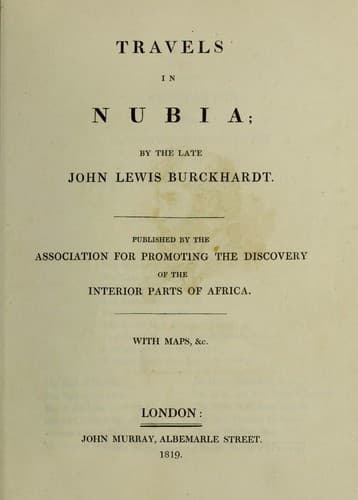
Burckhardt, John Lewis, 1784-1817; Nile River Valley -- Description and travel; Nubia -- Description and travel
or yellowish tint, according to the nature and colour of the ground,
from which the dust arises. The yellow however always, more or less,
predominates. In looking through a glass of a light yellow colour,
one may form a pretty correct idea of the appearance of the air,
as I observed it during a stormy Semoum at Esne, in Upper Egypt,
in May 1813. The Semoum is not always accompanied by whirlwinds; in
its less violent degree it will blow for hours with little force,
although with oppressive heat; when the whirlwind raises the dust
it then encreases several degrees in heat. In the Semoum at Esne the
thermometer mounted to 121° in the shade, but the air seldom remains
longer than a quarter of an hour in that state, or longer than the
whirlwind lasts. The most disagreeable effect of the Semoum on man
is, that it stops perspiration, dries up the palate, and produces
great restlessness. I never saw any person lie down flat upon his
face to escape its pernicious blast, as Bruce describes himself
to have done in crossing this desert; but during the whirlwinds
the Arabs often hide their faces with their cloaks, and kneel down
near their camels to prevent the sand or dust from hurting their
eyes. Camels are always much distressed, not by the heat but by the
dust blowing into their large, prominent, eyes. They turn round
and endeavour to screen themselves by holding down their heads,
but this I never saw them do except in case of a whirlwind, however
intense the heat of the atmosphere might be. In June 1813, going from
Esne to Siout, a violent Semoum overtook me upon the plain between
Farshiout and Berdys. I was quite alone, mounted upon a light-footed
Hedjin. When the whirlwind arose neither house nor tree was in sight,
and while I was endeavouring to cover my face with my handkerchief,
the beast was made unruly, by the quantity of dust blown into its
eyes, and the terrible noise of the wind, and set off at a furious
gallop; I lost the reins and received a heavy fall, and not being
able to see ten yards before me, I remained wrapped up in my cloak
on the spot where I fell, until the wind abated, when pursuing my
dromedary, I found it at a great distance, quietly standing near
a low shrub, the branches of which afforded some shelter to its eyes.
Bruce has mentioned the moving pillars of sands in this desert,
but although none such occurred during my passage, I do not presume
to question his veracity on this head. The Arabs told me that
there are often whirlwinds of sand, and I have repeatedly passed
through districts of moving sands, which the slightest wind can
raise; I remember to have seen columns of sands moving about like
water spouts in the desert on the banks of the Euphrates, and have
seen at Jaka terrible effects from a sudden wind; I therefore very
easily credit their occasional appearance in the Nubian desert,
although I doubt of their endangering the safety of travellers.
Public-domain text, read in full here on John Shaqi.
Reviews
Reviews
No reviews yet
Be the first to share your thoughts on this work.
Elsewhere in the archive
Join the Discussion
Join the discussion
Sign in to leave a comment or review.
Sign InorCreate an account