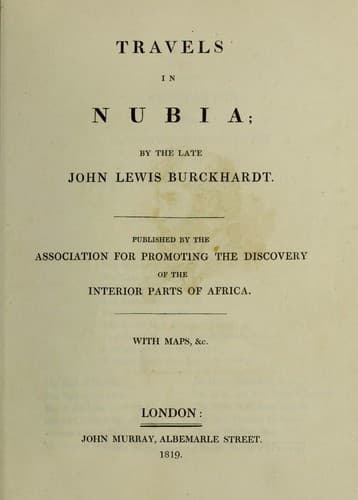
Burckhardt, John Lewis, 1784-1817; Nile River Valley -- Description and travel; Nubia -- Description and travel
The inhabitants of Berber are Arabs of the tribe of Meyrefab
(ميريفاب). In common with all the different Arab tribes who
inhabit the Nile valley, from Upper Egypt to Sennaar, they report
that their origin is from the Sherk, or east (من الشرق),
meaning Arabia. The name of Meyrefab however does not appear to be
from an Arabic root, and bears more resemblance to the Bisharein
language. None of the tribes who live on the banks of the Nile are
large, and each district is seldom more than one day’s march in
length. The territory of the Arabs Sheygya[11] is the largest. The
settlements of the Meyrefab extend only for six or eight hours along
the river, but many of them inhabit the neighbouring districts,
as foreign settlers. They say that the Meyrefab can arm a body
of one thousand free Arabs, and five hundred slaves, but in their
wars with their neighbours, they seldom appear with more than four
or five hundred men. Their chief is a man of their own tribe, who
assumes the title of Mek (an abbreviation of Melek, king), which is
common to all the petty chieftains of these countries, as far as
Darfour and Sennaar. The authority of the Mek is confined to the
reigning family, but is not hereditary from father to eldest son;
for the king of Sennaar, who, since the succession of the royal
family of Funnye has extended his authority along the Nile as
far north as the southern limits of Wady Mahass, nominates to the
governorship of this place any member of the family of Temsah whom
he pleases, or rather he sells it to the highest bidder, after the
Mek’s decease. With the exception of this nomination, the king of
Sennaar exercises no authority over Berber, but he sends every four
or five years one of his people to collect, in the way of tribute,
some presents, consisting of gold, horses, and camels; about twenty
horses and thirty camels. The kings of Dóngola, until the invasion
of the Mamlouks, had always paid a similar tribute to Sennaar, and
the Sheygya were bound to the same, but the latter having of late
become powerful, have refused to pay it any longer. A similar tribute
is exacted of the petty tribes between the Sheygya and Berber, and
the king of Sennaar names their chiefs in the same manner as he does
that of Berber. Many strangers beside the Meyrefab have settled at
Berber, particularly natives of Dóngola and Ababde Arabs from Upper
Egypt; many of these have taken up their constant residence here,
others are married at Berber, and have another family in Egypt.
Public-domain text, read in full here on John Shaqi.
Reviews
Reviews
No reviews yet
Be the first to share your thoughts on this work.
Elsewhere in the archive
Join the Discussion
Join the discussion
Sign in to leave a comment or review.
Sign InorCreate an account