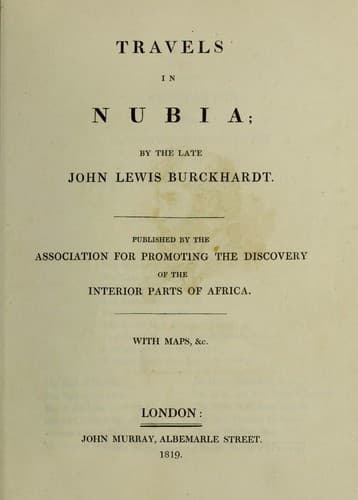
Burckhardt, John Lewis, 1784-1817; Nile River Valley -- Description and travel; Nubia -- Description and travel
The Mek exercises only a feeble authority over the Arabs of his
tribe, especially those who belong to powerful families; nor does
he exact any taxes from the fields or their produce, but he is
oppressive to strangers, the taxes and other exactions from whom
make up the best part of his income. The tribute which he pays to
Sennaar is collected from the whole tribe, and he takes care not
to be a loser by the contribution. The sums paid to Sennaar for
recognizing him in his office, after the decease of his predecessor,
are generally made up by a forced loan from any caravan that may
then be passing; and whichever individual of the reigning family
possesses the greatest influence, and most friends and money to
secure his election at Sennaar, easily places himself at the head
of the government.
The four villages of Berber are all at about half an hour’s walk
from the river situated in the sandy desert, on the borders of the
arable soil. Each village is composed of about a dozen of quarters,
Nezle (نزله), standing separate from one another, at short
distances. The houses are generally divided from each other by
large court-yards, thus forming no where any regular streets. They
are tolerably well built, either of mud or of sun-baked bricks, and
their appearance is at least as good as those of Upper Egypt. Each
habitation consists of a large yard divided into an inner and outer
court. Round this yard are the rooms for the family, which are all
on the ground floor; I have never seen in any of these countries a
second story, or staircase. To form the roof, beams are laid across
the walls; these are covered with mats, upon which reeds are placed,
and a layer of mud is spread over the whole. The roof has a slope to
let the rain water run off, which in most houses is conducted by a
canal to the court-yard, thus rendering the latter in time of rain
a dirty pond. Two of the apartments are generally inhabited by the
family, a third serves as a store room, a fourth for the reception
of strangers, and a fifth is often occupied by public women. The
rooms have seldom more than one very small window, so that to have
them well lighted the door must be kept open. The doors are of wood,
and have the same wooden locks and keys (Dabbé) which are used in
Syria and Egypt, but of still coarser workmanship. I have seldom
seen any furniture in the rooms, excepting a sofa or bedstead,
which is an oblong wooden frame, with four legs, having a seat
made either of reeds, and then called Serír, or of thin stripes
of ox-leather drawn across each other, and then called Angareyg (a
Bishary word). The best of the latter kind are brought from Sennaar;
many of them are exported to Upper Egypt, and Arabia, and they are
used all over the black countries. The honoured stranger always
has an Angareyg brought to him upon his arrival, which serves as
a bed for the night, and a sofa in the day, and it is said that
the peculiar smell of the leather keeps it free from vermin. Mats
Public-domain text, read in full here on John Shaqi.
Reviews
Reviews
No reviews yet
Be the first to share your thoughts on this work.
Elsewhere in the archive
Join the Discussion
Join the discussion
Sign in to leave a comment or review.
Sign InorCreate an account