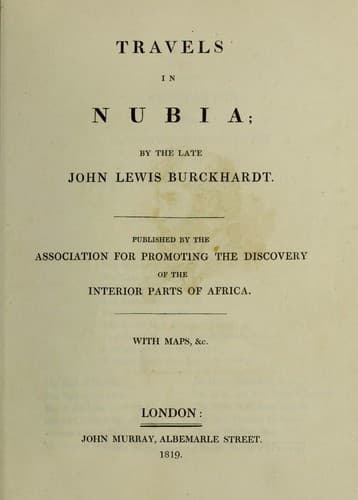
Burckhardt, John Lewis, 1784-1817; Nile River Valley -- Description and travel; Nubia -- Description and travel
made of reeds are spread in the inner part of the rooms where the
women sleep, as well as in other rooms, where the men take a nap
during the mid-day hours, a luxury never dispensed with in these
countries. When they sleep they generally spread a carpet made of
pieces of leather sown together, stretching themselves out upon
this, and preferring, according to the general custom of the Arabs,
to sleep without any pillow, and with the head lying upon the same
level with the rest of the body. In the store-room Dhourra is kept,
either in heaps upon the floor, or in large receptacles formed of
mud, to preserve it from rats and mice. Swarms of these animals
nevertheless abound, and they run about the court-yards in such
quantities that the boys exercise themselves in throwing lances at
them, and kill them every day by dozens. Besides the Dhourra, the
store rooms generally contain a few sheep-skins full of butter, some
jars of honey, some water-skins for travellers, and if the proprietor
be a man in easy circumstances, some dried flesh. The inner court
is generally destined for the cattle, camels, cows and sheep, and it
has a subdivision, where are preserved the dry Dhourra stalks, which
become the usual food of the cattle, when the summer heats have dried
up all the verdure which the inundation had produced. The outer court
in the generality of houses, contains a well of brackish water, fit
only for cattle; here the male-inhabitants of the house and strangers
sleep, during the hot season, either upon mud benches adjoining the
rooms, or upon Angareygs, or upon the ground; here the master’s
favourite horse is fed, and here all business is transacted in the
open air. I have already mentioned a room of public women, often
met with in these habitations. Indeed there are very few houses of
people called here respectable, where such women are not lodged,
either in the court-yard itself, or in a small room adjoining the
yard, but without its gate; in the house where I lodged, we had
four of these girls, one of whom was living within the precincts,
the three others in contiguous apartments. They are female slaves,
whom their masters, upon marrying or being tired of them, have
set at liberty, and who have no other livelihood but prostitution,
and the preparation of the intoxicating drink called Bouza. Female
slaves are often permitted to make a traffic of their charms before
they are at liberty, in order that they may acquire a sufficient
sum of money to purchase it. When at liberty their former owners
take care to make them pay house rent; some masters are said to
participate in their gains, and generally afford them protection
in the quarrels which frequently happen.
Public-domain text, read in full here on John Shaqi.
Reviews
Reviews
No reviews yet
Be the first to share your thoughts on this work.
Elsewhere in the archive
Join the Discussion
Join the discussion
Sign in to leave a comment or review.
Sign InorCreate an account