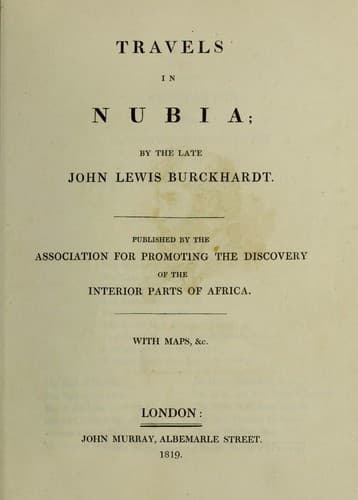
Burckhardt, John Lewis, 1784-1817; Nile River Valley -- Description and travel; Nubia -- Description and travel
In marrying, the bride’s father receives, according to the
Mussulman custom, a certain sum of money from the bride-groom, for
his daughter, and this sum is higher than is customary in other
parts inhabited by Arabs. The daughters of the Mek are paid as
much as three or four hundred dollars, which the father keeps for
them as a dowry. Few men have more than one wife, but every one who
can afford it keeps a slave or mistress either in his own or in a
separate house. Kept mistresses are called companions (فيقه),
and are more numerous than in the politest capitals of Europe. Few
traders pass through Berber without taking a mistress, if it be
only for a fortnight. Drunkenness is the constant companion of this
debauchery, and it would seem as if the men in these countries had
no other objects in life. The intoxicating liquor which they drink is
called Bouza (بوزه). Strongly leavened bread made from Dhourra is
broken into crumbs, and mixed with water, and the mixture is kept for
several hours over a slow fire. Being then removed, water is poured
over it, and it is left for two nights to ferment. This liquor,
according to its greater or smaller degree of fermentation, takes the
name of Merin, Bouza, or Om Belbel (ام بلبل), the mother of
nightingales, so called because it makes the drunkard sing. Unlike
the other two, which being fermented together with the crumbs of
bread, are never free from them, the Om Belbel is drained through
a cloth, and is consequently pure and liquid. I have tasted of all
three. The Om Belbel has a pleasant prickly taste, something like
Champagne turned sour. They are served up in large roundish gourds
open at the top, upon which are engraved with a knife a great variety
of ornaments. A gourd (Bourma بُرمه) contains about four pints,
and whenever a party meet over the gourd, it is reckoned that each
person will drink at least one Bourma. The gourd being placed on the
ground, a smaller gourd cut in half, and of the size of a tea-cup,
is placed near it, and in this the liquor is served round, to each
in turn, an interval of six or eight minutes being left between each
revolution of the little gourd. At the beginning of the sitting,
some roasted meat, strongly peppered, is generally circulated, but
the Bouza itself (they say) is sufficiently nourishing, and, indeed,
the common sort looks more like soup or porridge, than a liquor to
be taken at a draught. The Fakirs or religious men, are the only
persons who do not indulge (publicly at least) in this luxury; the
women are as fond of it, and as much in the habit of drinking it,
as the men. A Bourma of Bouza is given for one measure of Dhourra,
three-fourths of the measure of Dhourra being required to make the
Bourma, and the remainder paying for the labour.
Public-domain text, read in full here on John Shaqi.
Reviews
Reviews
No reviews yet
Be the first to share your thoughts on this work.
Elsewhere in the archive
Join the Discussion
Join the discussion
Sign in to leave a comment or review.
Sign InorCreate an account