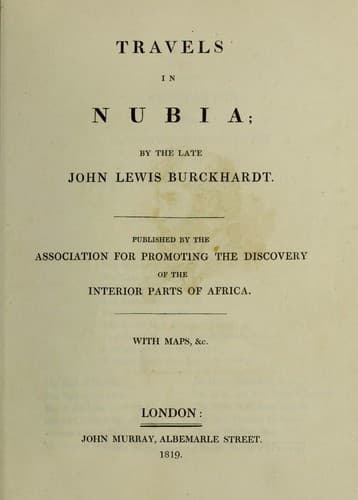
Burckhardt, John Lewis, 1784-1817; Nile River Valley -- Description and travel; Nubia -- Description and travel
In other respects the people of Berber are abstemious, and they
often fast the whole day, for the sake of being able to revel in the
evening. The chief article of food is Dhourra bread. As they have
no mills, not even hand-mills, they grind the Dhourra by strewing
it upon a smooth stone, about two feet in length and one foot in
breadth, which is placed in a sloping position before the person
employed to grind. At the lower extremity of the stone, a hole is
made in the ground to contain a broken earthen jar, wooden bowl, or
some such vessel, which receives the Dhourra flower. The grinding
is effected by means of a small stone flat at the bottom; this is
held in both hands and moved backwards and forwards on the sloping
stone by the grinder, who kneels to perform the operation. If the
bread is to be of superior quality, the Dhourra is well washed and
then dried in the sun; but generally they put it under the grinding
stone without taking the trouble of washing it. In grinding, the
grain is kept continually wet by sprinkling some water upon it from
a bason placed near, and thus the meal which falls into the pot,
resembles a liquid paste of the coarsest kind, mixed with chaff
and dirt. With this paste an earthen jar is filled, containing
as much as is necessary for the day’s consumption. It is left
there from twenty-four to thirty-six hours, during which time it
slightly ferments and acquires a sourish taste. No leaven is used;
the sour liquid is poured in small quantities upon an iron plate
placed over the fire, or when no iron is at hand, upon a thin well
smoothed stone: and if the iron or stone is thoroughly heated,
the cake is baked in three or four minutes. As each cake is small,
and must be baked separately, it requires a long time to prepare a
sufficient quantity; for it is the custom to bring several dozen
to table while hot, in a large wooden bowl; some onion sauce,
or broth, or milk, is then poured upon them, the sauce is called
Mallah (ملَّاح). The bread is never salted, but salt is
mixed with the sauce. This dish is the common and daily food both
at dinner and supper. Although very coarse it is not disagreeable,
and the sourish taste, renders it peculiarly palatable during the
heat of the mid-day hours. It is of easy digestion, and I always
found it agree with me; but if left to stand for a day it becomes
ill tasted, for which reason it is made immediately before dinner
or supper. Cakes of this kind, but still thinner, and formed of a
paste left for two or three days to turn quite sour, are made for
travelling provision. After being well toasted over the fire, they
are left to dry thoroughly in the sun, they are then crumbled into
small pieces and put into leather bags, called Abra (ابره). They
thus keep for many months, and serve to the traders upon occasions,
when it is impossible to prepare a supper with fire. Some melted
butter is poured over a few handfuls of this food, and appetite
is seldom wanting to make it palatable.
Public-domain text, read in full here on John Shaqi.
Reviews
Reviews
No reviews yet
Be the first to share your thoughts on this work.
Elsewhere in the archive
Join the Discussion
Join the discussion
Sign in to leave a comment or review.
Sign InorCreate an account