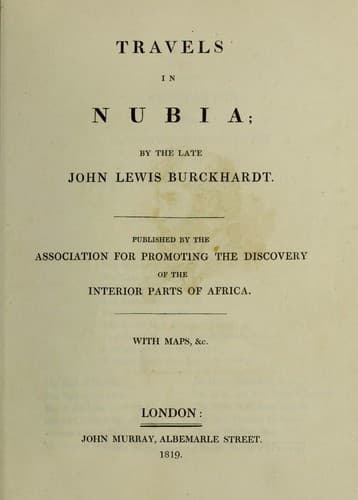
Burckhardt, John Lewis, 1784-1817; Nile River Valley -- Description and travel; Nubia -- Description and travel
Sometimes the crumbs are
soaked in water, and when the water has acquired a sourish taste it
is drank off; this is called by the traders “the caravan beverage,
Sharbet el Jellabe (شَربة الجَلَّابه).”
Meat is often brought upon the table boiled or roasted, and milk is
a principal food of the people. Dates are a great dainty; they are
imported by the Dongola merchants from Mahass, and are used only upon
extraordinary occasions. They are often boiled together with bread,
meat, and milk. Coffee is drank only by the merchants and the very
first people, and even by them it is not in daily use. The coffee
is not the Arabian or Mokha coffee, but that which grows wild in the
south-western mountains of Abyssinia, from whence it is imported by
the Sennaar merchants. It is sold thirty per cent. cheaper than the
Mokha coffee in Egypt, but its shape and taste appear to be the same.
The effects which the universal practice of drunkenness
and debauchery has on the morals of the people may easily be
conceived. Indeed every thing discreditable to humanity is found in
their character, but treachery and avidity predominate over their
other bad qualities. In the pursuit of gain they know no bounds,
forgetting every divine and human law, and breaking the most
solemn ties and engagements. Cheating, thieving, and the blackest
ingratitude, are found in almost every man’s character, and I am
perfectly convinced that there were few men among them or among my
fellow travellers from Egypt who would have given a dollar to save
a man’s life, or who would not have consented to a man’s death
in order to gain one. Especial care must be taken not to be misled
by their polite protestations, and fine professions, especially
when they come to Egypt: where they represent their own country as
a land inhabited by a race of superior virtue, and excellence. On
the contrary, infamous as the eastern nations are in general,
I have never met with so bad a people, excepting perhaps those
of Suakin. In transactions among themselves the Meyrefab regulate
every matter in dispute by the laws of the strongest. Nothing is
safe when once out of the owner’s hands, for if he happens to be
the weaker party, he is sure of losing his property. The Mek’s
authority is slighted by the wealthier inhabitants: the strength of
whose connections counterbalances the influence of the chief. Hence
it may well be supposed that family feuds very frequently occur,
and the more so, as the effects of drunkenness are dreadful upon
these people. During the fortnight I remained at Berber, I heard
of half a dozen quarrels occurring in drinking parties, all of
which finished in knife or sword wounds. Nobody goes to a Bouza
hut without taking his sword with him; and the girls are often the
first sufferers in the affray. I was told of a distant relation of
the present chief, who was for several years the dread of Berber. He
killed many people with his own hands upon the slightest provocation,
Public-domain text, read in full here on John Shaqi.
Reviews
Reviews
No reviews yet
Be the first to share your thoughts on this work.
Elsewhere in the archive
Join the Discussion
Join the discussion
Sign in to leave a comment or review.
Sign InorCreate an account