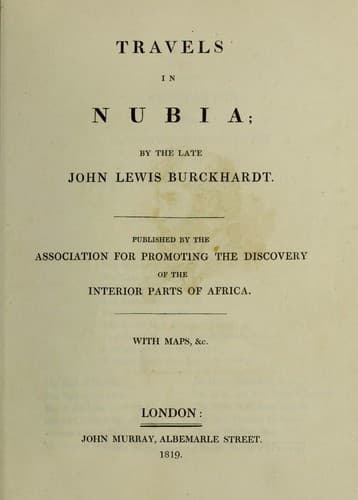
Burckhardt, John Lewis, 1784-1817; Nile River Valley -- Description and travel; Nubia -- Description and travel
Among the plagues that await the traveller in Berber the insolence
of the slaves is the most intolerable. Being considered as members
of the family in which they reside, they assume airs of importance
superior even to those of their masters. The latter are afraid to
punish or even seriously to reprimand them for their offences, as
they can easily find opportunities of running away, and by going
to the Bedouins or the Sheygya they are safe from any further
pursuit. One of the slaves of Edris, to whom I had already made
some little presents, tore my shirt into pieces because I refused to
give it him, and when I applied to Edris for redress, he recommended
patience to me, for that no insult was meant. The grown up slaves are
always armed; they hold themselves upon a par with the best Arabs,
and feel humbled only by the conviction that they cannot marry the
Arab girls. The insolence of the slaves, as well as of the people
in general, is in nothing more displayed than their behaviour with
regard to smoking; if they see a stranger with a pipe in his mouth,
they often take it from him without saying a word, and are unwilling
to return it before they have smoked it out. To a smoker, as all
the orientals are, nothing can be more disagreeable. The people of
Berber are themselves immoderately fond of tobacco, but they smoke
only at home when they expect no visitors, and scarcely ever carry
their pipes abroad, because tobacco is a very dear commodity, and
they fear lest the best whiff should fall to the lot of others. I
have often seen the Egyptian traders, men who would rather give
up their dinner than their pipe, reduced to desperation by the
impudence of their Berber visitors.
In a small treatise on physiognomy by Ali Ben Mohammed El Ghazali,
wherein he paints the characters of the different Mohammedan nations,
he thus describes the Nubians: “They are a people of frolic, folly
and levity, avaricious, treacherous and malicious, ignorant and base,
and full of wickedness and lechery.” This picture is true in every
part, applied to the people of Berber; for besides what I have
already said of them, they are of a very merry facetious temper,
continually joking, laughing, and singing. Even the elderly men
are the same, and they have at least retained one good quality of
their Arabian ancestors; they are not proud. The Mek of Berber is
satisfied with common civility, and assumes no distinction of rank;
the slaves of his family, shew much more haughtiness than himself.
Public-domain text, read in full here on John Shaqi.
Reviews
Reviews
No reviews yet
Be the first to share your thoughts on this work.
Elsewhere in the archive
Join the Discussion
Join the discussion
Sign in to leave a comment or review.
Sign InorCreate an account