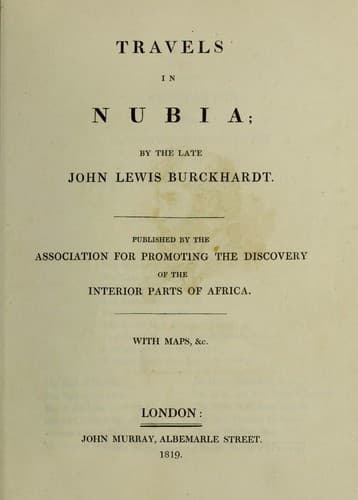
Burckhardt, John Lewis, 1784-1817; Nile River Valley -- Description and travel; Nubia -- Description and travel
The people of Berber, can be very polite when they think proper. In
receiving strangers and in offering them hospitality, they assume
an air of goodness of heart, and patriarchal simplicity, which might
dupe the most practised traveller, but consummate hypocrites as they
are, they seldom deceive those, who have been at Berber before. Their
language is full of complimentary phrases, and they ask after your
health and welfare in a dozen different forms of speech. After
a long absence they kiss and shake hands with eagerness. Women
are saluted by men in a very respectful manner, by touching their
foreheads with the right hand, and then kissing the part of the
fingers which touched the woman’s head. A common question asked
in saluting is Shedid? (strong?). A still more curious expression,
and one which I never heard before, is نَعلَك طَيب Naalak
Tayeb, “is your sole well?” meaning, “are you strong enough
to walk about as much as you like?” On meeting a person for the
first time after the death of a near relation, they kneel down
upon one knee by his side, and repeat in a howling tone of voice,
as a lamentation, “Fi’Sabil Allah, fi’Sabil Allah” (في
سَبيل اللَّه), literally, “in the road of God,” but
signifying that the deceased went through the right way of God and
may hope to obtain the divine protection. Then they lift up the
person, either man or woman, by the hand, and the common salutation
passes between them.
With some surprise, I observed that in an avowed Mussulman country,
the usual salute of “Salamun aleykum,” is quite out of use. The
general expression of salute is only the word Tayeb? (well);
repeated several times. The religious men only say sometimes,
“Salam Salam,” without any other word; but they never are
answered, as usual among Mussulmen, with Aleykum essalam, the common
reply being “Tayeb, ent tayeb? well, are you well? The members of
the Mek’s family are saluted by the appellation of “Ya Arbab”
(يا آرباب), plur. of “Rab,” (lord). They have the title
of “Ras,” meaning head, as Ras Edris, Ras Mohammed, &c. which
is used all over these countries; and from hence the same title
seems to have been introduced into Abyssinia. Government is called
with the pompous title of Es Saltane (السلطَنه), which is
not applied to the existing chief, but to the government in general.
Public-domain text, read in full here on John Shaqi.
Reviews
Reviews
No reviews yet
Be the first to share your thoughts on this work.
Elsewhere in the archive
Join the Discussion
Join the discussion
Sign in to leave a comment or review.
Sign InorCreate an account