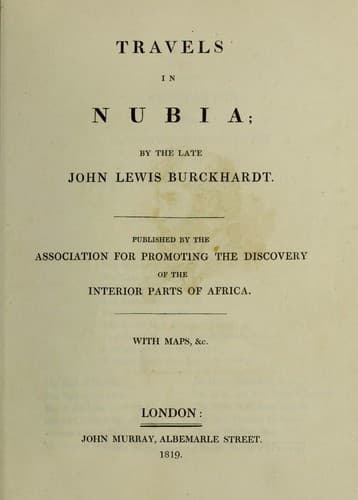
Burckhardt, John Lewis, 1784-1817; Nile River Valley -- Description and travel; Nubia -- Description and travel
The people of Berber appear to be a healthy race. There seemed to
be few invalids, and the place being situated on the skirts of the
desert, the air is certainly wholesome. I was told of a fever called
wardé (ورده), from woid (rose), which seems to be epidemic,
and often proves mortal; the people of Dóngola are very subject
to it; it exists during the time of high water, but does not make
its appearance every year. The plague is unknown, and from what I
heard during my former journey in Nubia, I have reason to believe
that it never passes the cataract of Assouan. The small-pox is
very destructive whenever it gains ground. Last year it was added
to famine, and deaths were very numerous. It had been brought to
Berber by the people of Taka, who had received it from the Souakin
traders; it spread over all the country up the Nile. Grown people
were attacked as well as children; it was observed even, that
the latter suffered less and that more of them escaped. About
one-third of those who were attacked recovered, but they bore
the marks on their skin, especially on the arms and face, which
were covered with innumerable spots and scars; very few instances
happen where the disease is of a mild kind, or where it leaves
but few marks. Inoculation, Dak-el-Jedri (دق الجدري),
is known, but not much practised; little benefit being supposed
to arise from it. The incision is usually made in the leg. Of
the large family of Temsah (our landlord’s), fifty-two persons
died within a few months, and while I am writing this (at Cairo,
December 1815), I hear from some traders, that the same disease
has again broken out, and that almost the whole family, including
Edris, have perished. Their only cure for the small pox is to rub
the whole body with butter three or four times a day, and to keep
themselves closely shut up. The disease generally visits them every
eight or ten years. They are infinitely more afraid of it than the
Levantines are of the plague: and great numbers of the inhabitants
emigrate to the mountains, to fly from the infection. I have heard
it said in Egypt, that the small pox is rendered more dangerous in
the negroe countries than elsewhere, by the thickness of the negroe
skin, the fever being increased by the resistance of such a skin,
to the efforts of the poison to break through it. This may be true
with respect to the negroe slaves, but is not probable at Berber,
where the people’s skin is quite as soft as ours. I saw few
instances of ophthalmia. Venereal complaints are said to be common,
but if it be so, their consequences appear to be less fatal than in
Egypt, for I never saw any of those ulcered faces, or mangled noses,
which are so common in the northern valley of the Nile.
Public-domain text, read in full here on John Shaqi.
Reviews
Reviews
No reviews yet
Be the first to share your thoughts on this work.
Elsewhere in the archive
Join the Discussion
Join the discussion
Sign in to leave a comment or review.
Sign InorCreate an account