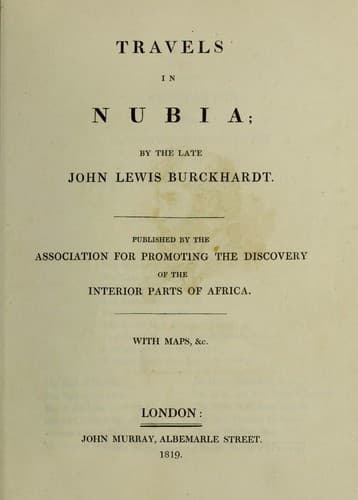
Burckhardt, John Lewis, 1784-1817; Nile River Valley -- Description and travel; Nubia -- Description and travel
The Meyrefab are partly shepherds, and partly cultivators. After
the inundation, they sow all the ground which has been inundated,
with Dhourra, and a little barley. Just before they sow, they turn
up the ground with the spade. The plough is not in use among them;
last year an Egyptian employed one for the first time. They have very
few water wheels, not more than four or five in the districts of
Ankheyre and Hassa. They sow only once a year, and as the banks of
the Nile are very high, higher in general than in Upper Egypt, many
spots of arable soil remain without being inundated. The deficiency
is not often supplied, as in Upper Egypt, by artificial irrigation,
for the purpose of procuring several crops from the same land, so
that it may easily be conceived, that famine often visits them. Thus
it happened the year before my arrival, when one _moud_ of Dhourra
was sold for half a Spanish dollar. The country, however, appears,
at no very remote period, to have enjoyed a more flourishing state
of culture than it does at present; for I observed in the fields
vestiges of deep canals, which are at present entirely neglected,
although by their help, even part of the adjoining desert plain
might be rendered cultivable. Dhourra is the principal produce of
the ground, and the chief food both of man and beast. Wheat is not
sown at Berber, and very little is found in any of the adjoining
countries. The Dhourra is of the same species as that of Upper
Egypt, but the stalks are much higher and stronger, rising often
to the height of sixteen or twenty feet. No vegetables are grown
except onions, kidney beans (Loubieh), the esculent mallow, or
Bahmieh,[16] and the Melukhyeh (ملوخيه), all of which are
common in Egypt. No fruits whatever are cultivated, and if I am
rightly informed, the lotus nebek, which grows wild, is the only
one known.
Public-domain text, read in full here on John Shaqi.
Reviews
Reviews
No reviews yet
Be the first to share your thoughts on this work.
Elsewhere in the archive
Join the Discussion
Join the discussion
Sign in to leave a comment or review.
Sign InorCreate an account