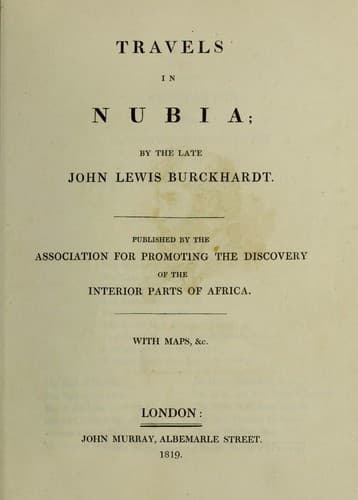
Burckhardt, John Lewis, 1784-1817; Nile River Valley -- Description and travel; Nubia -- Description and travel
I shall enter more into detail on the different articles of Negro
trade, when I come to speak of the Shendy market; both places deal in
the same commodities; there is much less trade, however, at Berber,
than at Shendy, from its having no direct intercourse with any
southern state, except Shendy, while the latter is visited by slave
caravans from all quarters, and is at present the first commercial
town, perhaps, of Africa, south of Egypt, and east of Darfour. All
the slaves, and every other article for sale in the Berber market,
come from Shendy; yet the Egyptian merchants often prefer this market
to the more southern ones, notwithstanding the increased charges;
because they can finish their business more quickly, and profit by
the first opportunity to return through the desert. During my stay
at Berber, a caravan set out for Daraou, consisting of about two
hundred and fifty camels, and twenty slaves; several of my companions
having disposed of their merchandize, returned with it. Still,
however, the Berber market contains but a small quantity of goods,
and is fit only for the Egyptian traders with small capitals.
In Upper Egypt the caravans from Berber are commonly called Sennaar
caravans; for the Egyptians having little knowledge of the southern
countries, all the caravans which arrive from thence are classed
under the two heads of Darfour and Sennaar, according as they enter
Egypt from the western or the eastern desert: the latter comprise
the caravans from Sennaar, Shendy, Berber, Mahass, and Seboua. Every
caravan arriving at Berber from the south remains there for some
time, in order to engage proper guides, and make other preparations
for the journey across the desert. Many of the Ababde are settled
here, and are always ready to undertake the journey; for twenty
dollars none will refuse to accompany a caravan, and they serve
both for guides and protectors. Many traders are well acquainted
with the route, but if unaccompanied by an Ababde, they would be
stripped by any Bedouin of the same tribe whom they might happen to
meet on the road. The caravans must pay at Berber a transit duty to
the Mek, the collection of which, from every individual, requires
several days. The Mek exacts from each person coming from Egypt,
without reference to the number of loads or camels he may have,
or whether he be a master or a servant, five Tob Dammour; his
officers must be paid one Tob, his slaves one Tob; and whenever
the chiefs of the Bisharein of the tribes of Are-ab and Ali-ab,
or their relations, meet a caravan here, they demand one Tob more;
this demand is made because the Bisharein are masters of the
desert from hence to the wells of Naby: to the north of Naby the
country is reckoned to be in the dominions of the Ababde, and may
thus be said to form part of Egypt, the Ababde being tributary to
the government of Egypt. The seven Tobs are collected by the Mek,
who distributes to his people their portion; the Bisharein collect
Public-domain text, read in full here on John Shaqi.
Reviews
Reviews
No reviews yet
Be the first to share your thoughts on this work.
Elsewhere in the archive
Join the Discussion
Join the discussion
Sign in to leave a comment or review.
Sign InorCreate an account