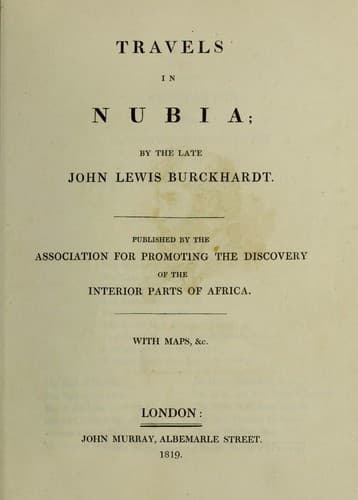
Burckhardt, John Lewis, 1784-1817; Nile River Valley -- Description and travel; Nubia -- Description and travel
The common currency of the country at Berber, and all the way from
thence to Sennaar, is Dhourra, and Spanish Dollars; every thing
of minor value has its price fixed in Dhourra, which is measured
by Selgas (سلقا), or handfuls. Eighteen Selgas make one Moud,
or measure: one Selga is as much as can be heaped upon the flat
extended hand of a full-grown man. It may easily be conceived that
disputes frequently arise between buyers and sellers, from the
unequal size of their hands; in such case a third person is usually
called in to measure the Dhourra: ten Mouds are now given for one
dollar. If a considerable quantity of Dhourra is to be measured
out, the contents of a wooden bowl, or other vessel, is previously
ascertained in handfuls, and this vessel is then used. They have,
it is true, Mouds, or measures of wood, but nobody trusts to them,
the hand-measure being always preferred. Besides the Dhourra,
another substitute for currency is the Dammour (دمّور), a
coarse cotton cloth, which is fabricated in the neighbourhood of
Sennaar, and principally used by the people of this country for
their shirts: one piece of Dammour is exactly sufficient to make
one shirt for a full grown man; this is called Tob, or Thob Dammour
(توب دمّور, plural تياب). When I was at Berber, one
dollar was paid for two Tob. The Tob Dammour is divided into two
Ferde Dammour; the Ferde (فرده) makes a long napkin, used by the
slaves to wrap round their waists. The Ferde contains two Fittige,
(فِتقِه) which serve for nothing else than a currency; thus
I remember to have bought some tobacco with a Fittige. Dhourra is
generally the most acceptable medium, as sellers will not always take
the Dammour at the real market price, which, moreover, varies on the
arrival of every caravan from the south. Slaves, camels, horses,
or any other articles of large amount, are paid for in dollars,
or Tob Dammour; but the broker takes his commission in Dhourra,
which he readily converts into dollars. In commerce, two reals,
or dollars, are called Kesme (قِسمه); four are termed Mithkal
(مثقال); eight, or half an ounce, Nosfwokye (نصف وقيه),
and sixteen are called Puma, or Wokye. These denominations were
taken originally from the gold weights, one ounce of gold being
generally worth about sixteen dollars; but they have now become
fixed appellations, and sixteen dollars are called Wokye, even
though the ounce of gold should be worth eighteen or twenty dollars,
as was the case during my stay at Berber.
In Cordofan, besides Dhourra and Dokhen, the usual currency is small
pieces of iron, which are wrought into lances, knives, axes, &c.;
besides these pieces of iron, _cows_ are used as a representative
of money in large bargains, and are thus continually transferred
from one person to another.
Public-domain text, read in full here on John Shaqi.
Reviews
Reviews
No reviews yet
Be the first to share your thoughts on this work.
Elsewhere in the archive
Join the Discussion
Join the discussion
Sign in to leave a comment or review.
Sign InorCreate an account