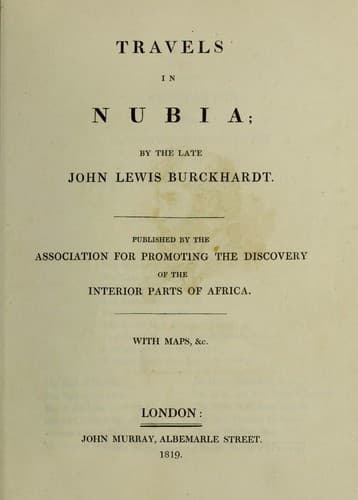
Burckhardt, John Lewis, 1784-1817; Nile River Valley -- Description and travel; Nubia -- Description and travel
The most wealthy man of Berber, next to the Mek, was pointed out
to me, with the observation that he possessed about two thousand
dollars, which he gained last year, during the famine, by happening
to have a full-stocked granary. The generality of the people styled
respectable possess from three to six hundred dollars each, including
the value of their cattle, household furniture, &c.
Berber has few channels of commercial intercourse, except Daraou
and Shendy. I was told that caravans used formerly to go from hence
to Dóngola, not along the Nile, because they would then be stopped
at every village for toll, but across the mountains on the western
bank of the river. Since the Arabs Rebatat have been at war with all
their neighbours, that road has been continually infested by them,
and has therefore been discontinued. At present the intercourse
with Dóngola is carried on by way of Shendy only, from whence the
caravans depart in a straight direction across the mountains. Many
merchants from Dóngola are settled here; they trade principally in
dates and tobacco; and their wives and slaves have the reputation of
making the best Bouza. The Bisharein Bedouins, and the husbandmen
on the banks of the river Mogren (the Mareb of Bruce), repair to
Berber to buy Dammour; and they purchase from the Egyptian traders
beads, antimony, nutmegs, and the various ingredients used in the
preparation of the perfumed grease already mentioned. Caravans
also arrive occasionally from Taka, across the eastern mountains,
a journey of ten or twelve days, to buy the same articles, or to
exchange ox hides and camels for them. Small caravans, composed
principally of Bisharein, come also from Souakin, a journey of ten
days, with spices and India piece goods, chiefly cambrics. This
route is not frequented by foreign traders, from apprehension of
the treachery of the Bisharein; but if any pilgrims happen to be
at Berber, in their way to Mekka, when one of these caravans sets
out on its return, they often take the same route, in which water
is found in plenty. The usual route of the Negro pilgrims, however,
is either along the banks of the Nile, or by way of Taka, of which I
shall speak hereafter. I had myself some idea of trying the journey
to Taka, from whence I had reason to hope that I might reach the
northern frontiers of Abyssinia, in the direction of Massouah. As
there were many people at Berber who had come from Sennaar, and as
these, upon being questioned, by my companions, about my pretended
lost relation, all agreed that no white man was then in Sennaar,
I was obliged to resort to the supposition that he had quitted it,
and gone on towards Abyssinia; I was thus enabled to make enquiries
concerning the route across the desert to Taka, and towards Souakin,
without creating suspicion; and my companions pressed me much
to travel in the latter direction, and to wait at Berber till a
favourable opportunity should offer for setting out. They would,
Public-domain text, read in full here on John Shaqi.
Reviews
Reviews
No reviews yet
Be the first to share your thoughts on this work.
Elsewhere in the archive
Join the Discussion
Join the discussion
Sign in to leave a comment or review.
Sign InorCreate an account