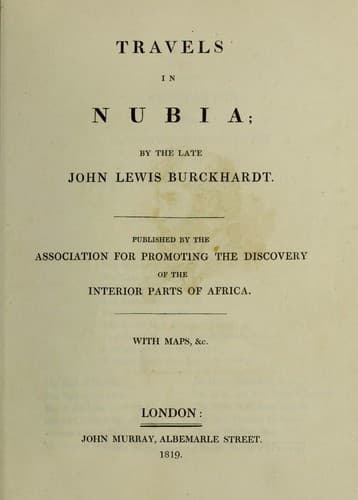
Burckhardt, John Lewis, 1784-1817; Nile River Valley -- Description and travel; Nubia -- Description and travel
Merchants always prefer taking up their abode in some respectable
house, and if possible in that of a relation of the chief, because
they are then protected by the authority of their landlord, who
would resent any serious insult offered to his guests. Our Ababde
guides, who were in no fear of any importunities, or insolence from
the Meyrefab, took up their quarters in the house of a poor Fakir,
where they were much more comfortable, and more at their ease than
ourselves. My companions made me contribute two dollars for my share
of the landlord’s bill; I paid, besides, one dollar for my quota
of the presents given to those who had sent us some dishes of meat
at different times; one dollar I exchanged for Dhourra to feed my
ass, and for a little tobacco: these, together with four dollars
to the chief at Berber, and three to the chief of the caravan, who
had a right to exact five; five dollars paid for the carriage of my
baggage, and four for that of my water-skins through the desert,
amounted to so considerable a sum, when compared with the state
of my purse, that I could not help entertaining some melancholy
thoughts on my future prospects.
When the day was at length fixed for our departure for Shendy,
whither the greater part of the merchants intended to carry their
goods, some presents were made up amongst our party for our landlord
Edris: he was not easily satisfied; his old wife too had some claims;
but after much quarrelling, he at last accepted merchandize to the
value of twenty dollars, as a recompense for having entertained us
in his house fourteen days. We were about a dozen in number, but the
daily expense did not, certainly, amount to more than one-third, or
half a dollar; for, except on the first day, when he killed a lamb
for us, we never partook of any other dish from his kitchen than
Dhourra bread, with butter, one large dish of which was served up
at mid-day, and another late at night. As we were only passengers,
and had no slaves with us, our meals were provided by the master of
the house; but when traders return hither, on their way to Egypt,
accompanied, as they usually are, by a number of female slaves,
the latter dress their masters victuals, and the owner of the house
is then paid only for his lodgings.
The preceding details respecting Berber are for the greater part
applicable to Shendy, and, as far as I could learn, to all the
petty Mekdoms from thence to Sennaar.
Public-domain text, read in full here on John Shaqi.
Reviews
Reviews
No reviews yet
Be the first to share your thoughts on this work.
Elsewhere in the archive
Join the Discussion
Join the discussion
Sign in to leave a comment or review.
Sign InorCreate an account