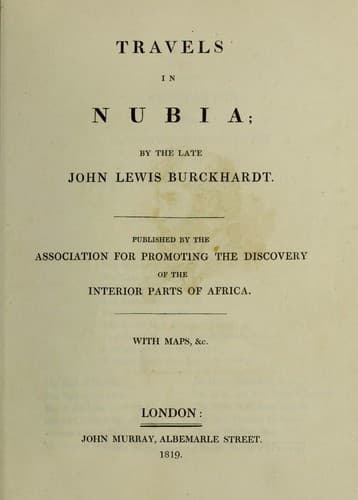
Burckhardt, John Lewis, 1784-1817; Nile River Valley -- Description and travel; Nubia -- Description and travel
Beyond Gabaty we rode alternately through the arable plain, and
the sandy hills. The former, where it is broadest, appears to
be about four miles in breadth, from the hills to the river. The
harvest had long been collected, but we saw the whole plain still
full of Dhourra stalks, not thickly crowded together as in Egypt,
but at wide intervals asunder, evidently shewing a great neglect of
cultivation. In the fields are many Nebek trees, and the borders of
the desert are everywhere overgrown with Oshour. We passed several
hamlets in the hills on our left; and at the end of ten hours,
late in the evening, reached Djebail (جبيل), a large village
in the hills, with several small mosques, and good buildings. It
is governed by a relative of the Mek of Shendy, whose district
extends as far as Hawaya. We encamped upon a piece of open ground
at the back of the village. After we had retired to rest we were
awakened by the servants of the principal Faky of the place, who
sent us a plentiful supper. During this day’s march we often met
passengers on the road, riding, for the most part, upon asses, and
also a small caravan from Shendy, on its way to Berber. I observed
several ancient dikes of earth, without any appearance of stone
or brick in them, and many canals for the purpose of irrigating
the plain, which were almost filled up with earth, and of little
or no use. Near Djebail begins a chain of mountains of sandstone,
running southwards, parallel with the river.
_April 17th._ At the end of two hours from Djebail, in crossing
the arable soil, we passed low mounds consisting of rubbish,
and red burnt bricks; they were about eighty paces in length,
and extended quite across the arable soil, for at least one mile
eastwards, turning, as I thought, towards their extremity, a little
more to the south. The bricks are of a very rude make, much coarser
than those now in use in Egypt. The mounds have the appearance of
having served as a wall, although but little remains by which to
form a judgment. Both on the northern and southern side we passed
some foundations of buildings, of moderate size, constructed of
hewn stones. These were the only remains of antiquity I could
discover; nor could I see any stones scattered amongst the mounds
of rubbish, as far, at least, as my sight could reach. A closer
examination might, perhaps, have led to some more interesting
discoveries, but I was in the company of the caravan, and had the
wonders of Thebes been placed on the road, I should not have been
able to examine them. At the end of three hours we came to Dawa
(داوه), a small village. The hills here take a direction more
to the east, and leave a plain of at least ten miles in breadth,
luxuriantly covered with wild plants, mixed with all the species
of the thorny acacias, and where are a great number of dispersed
huts and hamlets. The Arabs Djaalein here pasture their numerous
herds of cows, camels, and sheep. They have also a few water-wheels,
Public-domain text, read in full here on John Shaqi.
Reviews
Reviews
No reviews yet
Be the first to share your thoughts on this work.
Elsewhere in the archive
Join the Discussion
Join the discussion
Sign in to leave a comment or review.
Sign InorCreate an account