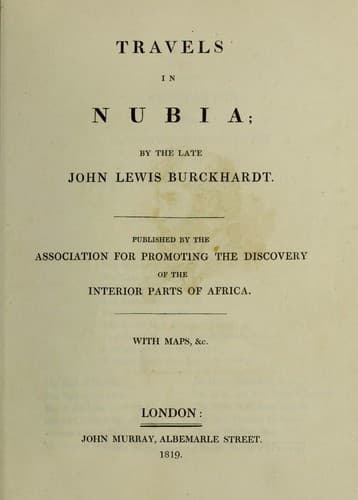
Burckhardt, John Lewis, 1784-1817; Nile River Valley -- Description and travel; Nubia -- Description and travel
_At Shendy from April 17th to May 17th._ We entered a large house
belonging to the friends of the Ababdes, situated on the skirts
of the town, towards the desert; but the next morning the Mek sent
one of his slaves to tell us, that he wanted that house himself for
one of his Abyssinian female slaves, who was to be inoculated with
the small-pox, and whom he wished to pass the time of her illness
in an open, airy, and insulated place. He ordered a house to be
prepared for us in the middle of the town, and we took possession
of it the next day; the owner was absent, but his wife gave us a
civil reception.
Next to Sennaar, and Cobbé (in Darfour), Shendy is the largest
town in eastern Soudan, and larger, according to the report of
the merchants, than the capitals of Dóngola and of Kordofan. It
consists of several quarters, divided from each other by public
places, or markets, and it contains altogether from eight hundred to
a thousand houses. It is built upon the sandy plain, at about half
an hour’s walk from the river; its houses are similar to those
of Berber; but it contains a greater number of large buildings,
and fewer ruins. The houses seldom form any regular street, but are
spread over the plain in great disorder. I nowhere saw any walls of
burnt bricks. The houses of the chief, and those of his relatives,
contain court-yards twenty feet square, inclosed by high walls, and
this is the general description of the habitations of Shendy. The
government is in the hands of the Mek; the name of the present
chief is Nimr (نِمر), i. e. Tiger. The reigning family is of
the same tribe as that which now occupies the throne of Sennaar,
namely the Wold Adjib(ولد عجيب), which, as far as I could
understand, is a branch of the Funnye. The father of Nimr was an
Arab of the tribe of Djaalein, but his mother was of the royal
blood of Wold Adjib; and thus it appears that women have a right
to the succession. This agrees with the narrative of Bruce, who
found at Shendy a woman upon the throne, whom he calls Sittina (an
Arabic word meaning our Lady). The Mek of Shendy, like the Mek of
Berber, is subject to Sennaar; but, excepting the purchase money
paid for his government, on his accession, and occasional presents
to the king and vizier[21] of Sennaar, he is entirely independent,
and governs his district, which extends about two days journeys
farther to the south, quite at his own pleasure.
Public-domain text, read in full here on John Shaqi.
Reviews
Reviews
No reviews yet
Be the first to share your thoughts on this work.
Elsewhere in the archive
Join the Discussion
Join the discussion
Sign in to leave a comment or review.
Sign InorCreate an account