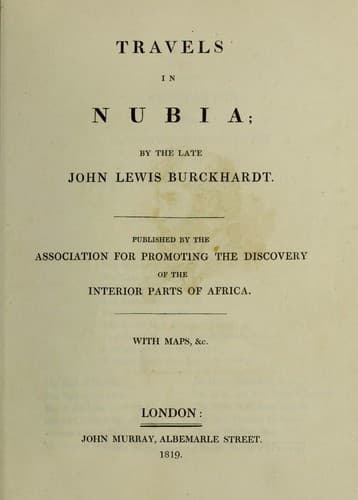
Burckhardt, John Lewis, 1784-1817; Nile River Valley -- Description and travel; Nubia -- Description and travel
Commerce flourishes at Shendy because the Mek does not extort any
taxes from the merchants, which many people assured me he dared
not do from his fear of the vizier of Sennaar. I am not able to
judge how far this may be true; but the fact is, that caravans pay
nothing whatever by way of duty; they generally make up a small
present to the Mek, in order to enjoy his particular protection, and
add something further for one of his brothers, who is a principal
man in the place. Our party of Ababdes sent him a small parcel of
soap and sugar, of which my quota amounted to half a dollar. I did
not hear of any subordinate offices in the government of Shendy,
and the Mek seems to unite all the branches of authority in his
own person. His relatives are the governors of villages; and his
court consists of half a dozen police officers, a writer, an Imam,
a treasurer, and a body guard, formed principally of slaves. The
character of the people is much the same as that of the inhabitants
of Berber. They are kept in some order, it is true, by the Mek;
but wickedness and injustice govern all their conduct, for they
know that the law can do little more than endeavour to prevent
crimes, and that it very seldom punishes them. Nightly robbers,
drunken people who have assaulted strangers, thieves detected in
the market, &c. &c. are often carried before the Mek, but he is
generally satisfied with imprisoning them for two or three days;
and I did not hear a single instance of his having ordered any
person to be put to death, or even flogged, although such crimes as
I have mentioned were committed daily during my stay at Shendy. The
delinquents were permitted to return quietly to their homes, on
paying a small fine to the Mek and his people. I was told that at
Kordofan thieves are always punished with death.
Debauchery and drunkenness are as fashionable here as at Berber;
the latter, I think, is even more common. No night passed without my
hearing the loud songs of some Bouza meeting, though our quarter,
that of the Dongoláwy, who are too avaricious to be addicted to
these vices, was one of the quietest. At Berber public women were
constantly seen in the street; at Shendy I very seldom met any of
them, though within the inclosures of the houses they are almost
as numerous as at Berber.
The dress, habits, and manners of the inhabitants of Shendy are the
same as those of the places last described, and appear to prevail as
far as Darfour, and Sennaar. I observed more well dressed people at
Shendy than at Berber, and clean linen was much oftener seen. Gold
being a very current article in the Shendy market, the women have
more frequently golden rings at their noses and ears than those
of Berber; the people also possess more wealth. It is not uncommon
to see a family possessed of a dozen slaves, acting as servants in
the house, and labourers in the field.
Public-domain text, read in full here on John Shaqi.
Reviews
Reviews
No reviews yet
Be the first to share your thoughts on this work.
Elsewhere in the archive
Join the Discussion
Join the discussion
Sign in to leave a comment or review.
Sign InorCreate an account