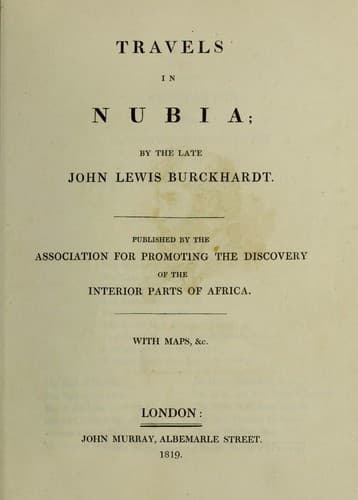
Burckhardt, John Lewis, 1784-1817; Nile River Valley -- Description and travel; Nubia -- Description and travel
The people of Shendy, like those of Berber, are shepherds,
traders, and husbandmen. Agriculture, however, seems to be little
thought of by the inhabitants themselves, being chiefly left to
the Arab peasants of the vicinity; the cultivable soil in the
neighbourhood of the city is narrow; but to the north and south
of it are some fine arable plains. Water-wheels are common; they
are erected generally on those parts of the high banks, which the
most copious inundations of the river cannot overflow; by means of
them the cultivators raise one winter crop; but they are too lazy
to bestow the labour necessary for watering the soil a second or
third time, as is done in the most elevated parts of Upper Egypt,
where also the river very seldom rises high enough to overflow the
banks. Dhourra is the chief produce; Dokhen and wheat are sown in
small quantities, the former for the consumption of the western
traders who visit Shendy, the latter almost exclusively for the
families of the great. Large quantities of onions, some red pepper
(brought from Kordofan), Bamyes, chick-peas (حُمّص), Meloukhye,
and Tormos,[22] are always found in the market either green or
dried. During the inundation some water-melons and cucumbers are
sown, but for the use only of the Harem of the Mek.
The cattle is very fine; and the inhabitants say that their size
and quality continue to increase, in proportion as you ascend
the river. I saw no domestic animals that are not common in
Egypt. Elephants are first met with at Abou Heraze, two or three
days to the north of Sennaar; and they have never been known to
pass to the northward of that district, which is bounded by a chain
of mountains six or eight hours in breadth, reaching close to the
river. I was told that tigers are frequently seen in the Wadys
east of Shendy. In the mountains of Dender, a district towards the
Atbara, and six or eight journies south-east of Shendy, the giraffa
is found (Arabic, Zerafa, ظرافه, i. e. the elegant). It is
hunted by the Arabs Shukorein and Kowahel, and is highly prized for
its skin, of which the strongest bucklers are made. I frequently
saw mountain-goats of the largest size brought to the market of
Shendy; they have long horns bending to the middle of the back;
their flesh is esteemed a great dainty. They call them Areal
(آريَل), a name given in Syria to the red deer. In Upper
Egypt they are called Teytal (تيتل), and in Syria Beden
(بَدَن). They are caught by the Djaalein Bedouins in nooses,
in the same manner as they catch ostriches, which are also very
common in this neighbourhood. The ostrich-feathers however are
inferior to those of the western deserts. Those most esteemed in
Egypt are from Kordofan and Darfour, which the caravans from the
latter place bring to Siout. The Djaalein peasants bring the feathers
to the market in bundles, good and bad together, and exchange them
for Dhourra. Their price, when I was at Shendy, was about one-tenth
Public-domain text, read in full here on John Shaqi.
Reviews
Reviews
No reviews yet
Be the first to share your thoughts on this work.
Elsewhere in the archive
Join the Discussion
Join the discussion
Sign in to leave a comment or review.
Sign InorCreate an account