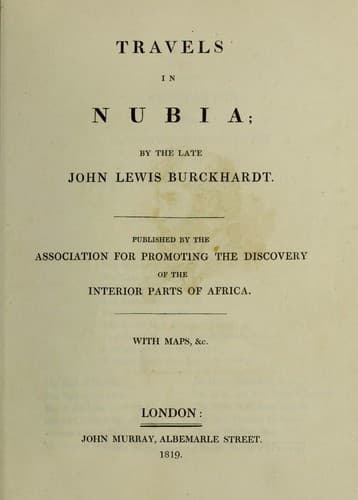
Burckhardt, John Lewis, 1784-1817; Nile River Valley -- Description and travel; Nubia -- Description and travel
Shendy has a daily, and one large weekly market, which is frequented
by all the surrounding Arabs. The common currency is the same
as that at Berber, viz. Dhourra and Dammour. Slaves and camels
are generally bought with dollars, or whole parties of slaves are
bartered for Egyptian and Souakin merchandize. Of dollars those only
are current that are coined in Spain. They are called Abou Medfaa
(ابو مدفع), from having the supposed figure of a gun on
the reverse, or Abou Amoud (ابو عمود), from the columns:
none pass current but those with the inscription Carolus IIII.,
which they term Reyal Abou Areyaa (ريال ابو اريع), and
these numerals, or lines, must be visible upon the dollar to make
it pass at its full value. They say that the dollars with Carolus
III. must be of less value, because they have only three lines,
whence they are estimated at one-sixth below the real value. Those
coined under the Ferdinands lose one-third. Austrian dollars are not
taken at all. During my stay at Shendy, I found a blacksmith secretly
employed in adding an I to the dollars of Charles III., for which
he received two measures of Dhourra per dollar. This distinction of
the numerals, it is said, was first made by the Bedouins; as it is
now known amongst the merchants, little inconvenience arises from
it. Gold coins have no currency; but pure gold, in small pieces,
or lumps, or ear-rings, can always be procured from the Sennaar
merchants at the market price. I never saw any gold dust in the
possession of the traders during the whole of my journeys. The
Mamelouks had sent one of their servants to Shendy with Venetian
zecchins, and Turkish gold coins, in order to exchange them for
dollars; the Egyptians bought them up at half their value, but they
afterwards repented of it, when they recollected that they might
have employed their dollars in other purchases, which would have
returned them more than fifty per cent. profit in Egypt.
The market of Shendy is held upon a wide open space between the
two principal quarters of the town. Three rows of small shops
built of mud, one behind the other, in the shape of niches, about
six feet in length by four feet in depth, and covered by mats,
are occupied by the more opulent tradesmen, who carry their goods
to their respective shops every morning, and back to their houses
in the evening, as these shops have no door by which they can be
secured. The other merchants sit upon the ground, under a kind of
shed or awning of mats supported by three long poles, which can
be turned in all directions, to keep off the sun, so as to afford
sufficient shade to the seller and his customers at all times of the
day. Similar awnings are in common use in the Hedjaz. The articles
usually offered for sale in the daily market are the following:
Public-domain text, read in full here on John Shaqi.
Reviews
Reviews
No reviews yet
Be the first to share your thoughts on this work.
Elsewhere in the archive
Join the Discussion
Join the discussion
Sign in to leave a comment or review.
Sign InorCreate an account