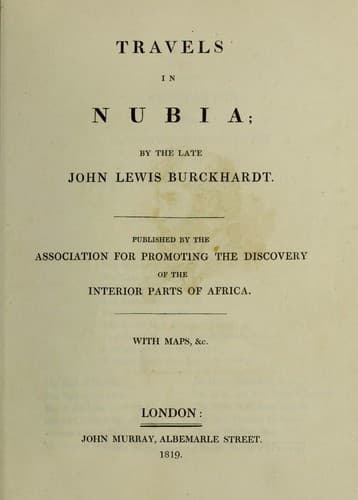
Burckhardt, John Lewis, 1784-1817; Nile River Valley -- Description and travel; Nubia -- Description and travel
_Butchers Meat._ Cows and camels are slaughtered daily for this
supply, but sheep very seldom. I did not hear that they were in the
habit of emasculating the animals destined for the shambles. The
tallow is sold by particular merchants, who wash and cleanse it,
in order to make it fit for anointing the hair and skin. Close by
the butchers shops are sold pieces of roasted fat, upon which and a
little Bouza, the Bedouins of the desert usually dine when they come
to the town. The flesh is not weighed, but sold in lots of about two
or three pounds weight. Weights, in general, are only met with in
the merchants own houses; in the market they use for this purpose
stones, by means of which the sellers have often an opportunity of
cheating. The pound or rotolo is equal to that of Cairo.
_Milk._ In the morning both fresh and sour milk is brought in by
Bedouin girls, and exchanged for Dhourra; they carry with them
small wooden bowls, one of which the buyer fills with the grain,
and receives in return three measures of milk; these girls also
sell boiled chick-pease and boiled Tormous, both of which are a
favourite breakfast, and called Belileh (بِليله). Bread is
never sold in the market; but there are many women living in poor
huts in different parts of the town, who, for a trifling recompense,
immediately grind the Dhourra, and make it into bread. It is an
established custom not to eat in the market-place, nor any where in
public; it is even considered very indecorous for a person to be seen
chewing any food beyond the threshold of his own house: the reason
of this is a superstitious notion that a hungry man may observe the
eater and may envy the morsels he puts into his mouth; for there
is no blessing, they say, or nutriment in food upon which another
has cast an envious eye (الطعام المحسود مافيه
بَرَكة). It is for the same reason that in the Levant, the
meanest peasant never eats his dinner of bread and onions without
exclaiming (بِسمللّه) Besmillé, and inviting every one
who passes by to partake with him; and he considers it a great
favour if a small portion of his loaf is accepted, and as great an
insult if his offer is silently refused; he expects, according to
the custom of the country, that the person invited should answer
him at least with the word Hannyan (هَنّياً _prosit_), if
he does not choose to eat with him. In Turkey, this custom is not
observed; and people may often be seen eating in the market places,
and before their own houses. I often bought milk early in the morning
in the market at Shendy, and then retired into a neighbouring hut,
to drink it; but I was obliged to give the woman of the hut a
handful of Dhourra for permission to do so.
Public-domain text, read in full here on John Shaqi.
Reviews
Reviews
No reviews yet
Be the first to share your thoughts on this work.
Elsewhere in the archive
Join the Discussion
Join the discussion
Sign in to leave a comment or review.
Sign InorCreate an account