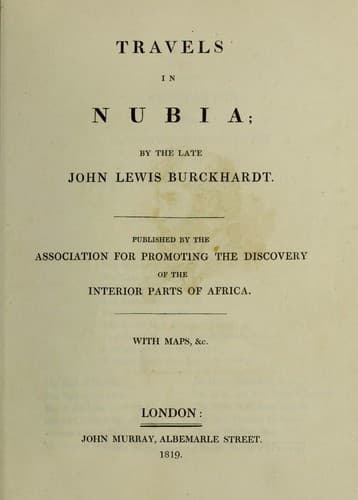
Burckhardt, John Lewis, 1784-1817; Nile River Valley -- Description and travel; Nubia -- Description and travel
The grocers and druggists shops are the most frequented of any;
there are always half a dozen of them opened, in which are sold
cloves (قرنفل), pepper, cardamoms, (حَبّ الحال), and
tamarinds, called here Erdeyb (عِرديب), which are brought from
Kordofan, in small cakes. The tamarinds are prepared by exposing
the pulse together with the beans to the sun until they approach
putrefaction, in which state they are kneaded into cakes. The best
sort grows to the N. W. and W. of Darfour, between that country
and Dar Saleht; but they abound also in the neighbourhood of
Kordofan. The people of Shendy dissolve the cakes in hot water,
which they drink as a refreshing beverage. Many camel loads of
this excellent fruit are carried to Egypt; it is called Tamerhindy
(تمرهندي), _the date of India_, at Cairo, where it is in part
imported from the East-Indies. I have seen considerable quantities
of it in the hands of the Indian merchants, at Djidda, where it
is called Homar (حُمر); but this sort is much cheaper than
the other, being loose, not made into cakes, and of an inferior
quality. The Tamerhindy tree grows at Mekka[24] and in different
parts of the Hedjaz.
_Sandal wood_ is imported from India, in considerable quantities;
it forms one of the ingredients of the perfumed paste with which
they rub the skin; and in cases of sickness the patient’s room
is perfumed with it by strewing chips of the wood upon burning
charcoal. It is sold in pieces about six inches in length. Much of
it is carried to Sennaar.
_Fenugreek_ (Helbeh, حلبه) is brought from Egypt, and used by
the medical practitioners in this part of the country as a tonic.
The _Liban_ (لبان) is a species of gum, collected by the Bedouin
Arabs who inhabit the deserts between Kordofan and Shilluk, on the
road to Sennaar. It is said to exude from the stem of a tree in the
same manner as gum arabic. It is sold in small thin cakes, is of a
dull gray colour, very brittle, and has a strong smell. The country
people use it as a perfume, but it is dear. It is much in demand for
the inhabitants of Taka, and all the tribes between the Nile and the
Red Sea. It is exported to Souakin; the Cairo merchants receive it
from Djidda. At Cairo it is considered as the frankincense, and is
called Incenso. There are two sorts, one of which is much coarser
than the other. It is also imported into Djidda from Souahal, on the
eastern coast of Africa, beyond Cape Gardafui; and from Abyssinia,
by the way of Massouah; but this last is of an inferior quality.
Public-domain text, read in full here on John Shaqi.
Reviews
Reviews
No reviews yet
Be the first to share your thoughts on this work.
Elsewhere in the archive
Join the Discussion
Join the discussion
Sign in to leave a comment or review.
Sign InorCreate an account