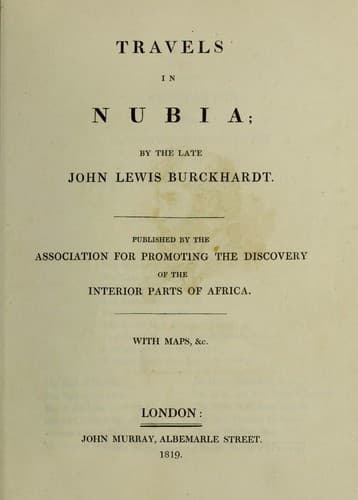
Burckhardt, John Lewis, 1784-1817; Nile River Valley -- Description and travel; Nubia -- Description and travel
_Gum arabic_ is sold in small quantities in the markets of Shendy;
but loads of it may always be had of the Sennaar or Kordofan
merchants; that of which the fine white colour causes it to be
most esteemed comes from Kordofan, from the districts inhabited
by the Bedouins Fadhel. The trade in gum arabic by this route has
of late been of little consequence, as the profits arising from
it are much less than those on slaves and camels; but the Darfour
caravan continues to import it. It is now, however, become scarce
and dear in Egypt, and will therefore, probably, be again imported
in large quantities.
_Shishm_ (ششم), a small grain of the size and shape of the
smallest lentils, of a deep black, shining colour, is imported
from Darfour. It is pulverised and rubbed into the eyelids for
complaints of the eyes. The Darfour caravans carry large quantities
of this grain to Egypt, where it is much more in request than in
the southern countries; there it is in general use amongst all
classes, rather as a preserver of the eyes, than as a remedy for
ophthalmia. It certainly communicates a refreshing coolness to the
eye. I did not understand that any of it was exported from Egypt.
_Antimony_ is sold in large quantities to people from all parts, and
of all descriptions, to blacken the eyelids. In the open country,
small pieces of antimony (Kohhel) often answer the purpose of a
currency, as the peasants wives will always readily barter for it
any thing that their house can afford.
A drug called _Kerfé_[25] (قرفه), i. e. bark, is imported by
the western merchants; it is a yellow-coloured bark, of considerable
thickness, of a fibrous texture, and apparently belonging to a
shrub, or the smaller branches of a tree, being about an inch in
diameter. A decoction of it is used as an astringent in fever and
dysentery; it has a very bitter taste. I was told that the tree or
shrub from which this bark is procured, grows also in the mountains
towards Abyssinia, in the country of the Shukorye.
I had collected small specimens of the articles above enumerated;
but I unfortunately lost them through the negligence of my companions
during the voyage from Souakin to Djidda. Amongst them was some of
the fruit Allobé, brought from Sennaar and Kordofan. In its dry
state it is of the size of a pigeon’s egg, of a brownish yellow
colour, with a large kernel, inveloped in a thin fleshy substance,
which has a sub-acid, and rather agreeable taste. It is eaten as
a dainty; and is believed to be a remedy for flatulency, of which
many people here complain. It is likewise called Tamr el berr
(تمر البرّ),[26] or the date of Soudan. The Allobé is said
to grow on a large tree. The people of Kordofan are extremely fond
of it. I have seen at Cairo a specimen of a fruit called Zakkoum,
from the plains of Ramle, in Palestine, which appeared to me to be
the same as the Allobé.
Public-domain text, read in full here on John Shaqi.
Reviews
Reviews
No reviews yet
Be the first to share your thoughts on this work.
Elsewhere in the archive
Join the Discussion
Join the discussion
Sign in to leave a comment or review.
Sign InorCreate an account