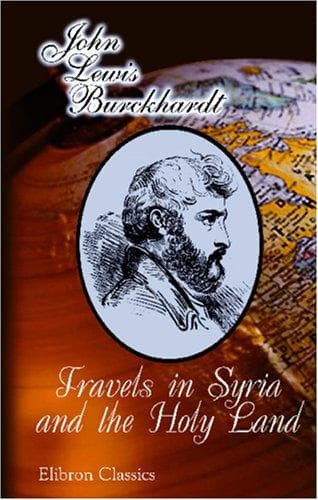
Travels in Syria and the Holy LandBurckhardt, John Lewis
History
Travels in Syria and the Holy Land
Burckhardt, John Lewis
Palestine -- Description and travel; Syria -- Description and travel
[p.188]of mulberry leaves, eight or ten trees, in common years, yielding
one load; and as the income of the proprietors depends entirely upon the
growth of these leaves, they suffer less from a bad crop, because their
taxes are proportionally low. The extraordinary extortions of the
government, however, are excessive: the Emir often exacts five or six
Miris in the year, and one levy of money is no sooner paid, than orders
are received for a fresh one of twenty or thirty purses upon the
province. The village Sheikh fixes the contributions to be paid by each
village, taking care to appropriate a part of them to himself. Last year
many peasants were obliged to sell a part of their furniture, to defray
the taxes; it may easily be conceived therefore in what misery they
live: they eat scarcely any thing but the worst bread, and oil, or soups
made of the wild herbs, of which tyranny cannot deprive them.
Notwithstanding the wretchedness in which they are left by the
government, they have still to satisfy the greediness of their priests,
but these contributions they pay with cheerfulness. Many of the convents
indeed are too rich to require their assistance, but those which are
poor, together with all the parish priests and church officers, live
upon the people. Such is the condition of this Christian commonwealth,
which instead of deserving the envy of other Christians, living under
the Turkish yoke, is in a more wretched state than any other part of
Syria; but the predominance of their church consoles them under every
affliction, and were the Druse governor to deprive them of the last
para, they would still remain in the vicinity of their convent.
Contributions are never levied on the convents, though the landed
property belonging to them pays duties like that of the peasant; their
income from abroad is free from taxes. Loans are sometimes required of
the convents; but they are regularly reimbursed in the time of the next
harvest. The priests are the most
NAHR EL KELB.
[p.189]happy part of the population of Kesrouan; they are under no
anxiety for their own support; they are looked upon by the people
assuperior beings, and their repose is interrupted only by the intrigues
of the convents, and by the mutual hostilities of the bishops.
The principal villages in Kesrouan, beginning from the north, are
Ghadsir [Arabic], Djedeide [Arabic], Aar Amoun [Arabic], Shenanayr
[Arabic], Sahel Alma [Arabic], Haret Szakher [Arabic], Ghozta [Arabic],
Deir Aoun [Arabic], Ghadir [Arabic], Zouk Mikayl [Arabic], Djouni
[Arabic], Zouk Meszbah [Arabic], Zouk el Kherab [Arabic], and Kornet el
Khamra [Arabic].
Public-domain text, read in full here on John Shaqi.
Reviews
Reviews
No reviews yet
Be the first to share your thoughts on this work.
Elsewhere in the archive
Join the Discussion
Join the discussion
Sign in to leave a comment or review.
Sign InorCreate an account