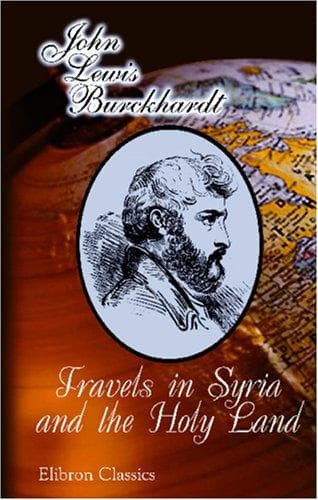
Travels in Syria and the Holy LandBurckhardt, John Lewis
History
Travels in Syria and the Holy Land
Burckhardt, John Lewis
Palestine -- Description and travel; Syria -- Description and travel
March 18th--I left my amiable host, the Abate Gandolfi, and proceeded on
my road to Deir el Kammar, the residence of the Emir Beshir. One hour
from Antoura is Deir Lowyz [Arabic]. Between it and the village Zouk
Mikayl lies the village Zouk Meszbah, with Deir Mar Elias. South of Deir
Lowyz half an hour is the village Zouk el Kharab; half an hour E. of the
latter, Deir Tanneis [Arabic], and about the same distance S.E. the
village Kornet el Khamra. From Deir Lowyz I again descended into the
plain on the sea shore. The narrow plain which I mentioned as beginning
at Djissr Maammiltein, continues only as far as Djouni, where the
country rises, and continues hilly, across the southern promontoy of the
bay of Kesrouan, on the farther side of which the narrow plain again
begins, and continues as far as the banks of the Nahr el Kelb. I reached
this river in half an hour from Antoura, at the point of its junction
with the sea, about ten minutes above which it is crossed by a fine
stone bridge. From the bridge the road continues along the foot of the
steep rocks, except where they overhang the sea, and there it has been
cut through the rock for about a mile. This was a work, however, of no
great labour, and hardly deserved the
EL MELLAHA.
[p.190]following magnificent inscription, which is engraved upon the
rock, just over the sea, where the road turns southward:
IMP CAES M AVRELIVS ANTONINV S . PIVS . FELIX . AVGVSTVS PART . MAX .
BRIT . MAX . GERM . MAXIMVS PONTIFEX . MAXIMVS MONTIBVS INMINENTIBVS
LICO FLVMINI CAESIS VIAM DELATAVIT PER . . . . . . . . . . . . .
ANTONINIANAM SVAM
The last line but one has been purposely erazed. Below the frame in
which the above is engraved, is this figure.
Higher up in the road are several other places in the rock, where
inscriptions have been cut, but the following one only is legible:
INVICTIM ANTONIN FELIX AUG MV . . IS NISIM[In the year 1697 Maundrell
read this inscription as follows: Invicte Imp. Antonine P. Felix Aug.
multis annis impera. Ed.]
According to the opinion of M. Guys, the French consul at Tripoli, which
seems well founded, the Emperor mentioned in the above inscriptions is
not Antoninus Pius, but Caracalla; as the epithet Britannus cannot be
applied to the former, but very well to the latter. Opposite to the
bridge is an Arabic inscription, but for the greater part illegible.
The road continues for about half an hour through the rock over the sea,
above which it is no where higher than fifty feet. At the southern
extremity is a square basin hewn in the rock close by the sea, called El
Mellaha, in which the salt water is sometimes collected for the purpose
of obtaining salt by evaporation. On the summit of the mountain, to the
left of the rocky road, lies the Deir Youssef el Berdj [Arabic]; half an
PLAIN OF BEIROUT.
Public-domain text, read in full here on John Shaqi.
Reviews
Reviews
No reviews yet
Be the first to share your thoughts on this work.
Elsewhere in the archive
Join the Discussion
Join the discussion
Sign in to leave a comment or review.
Sign InorCreate an account