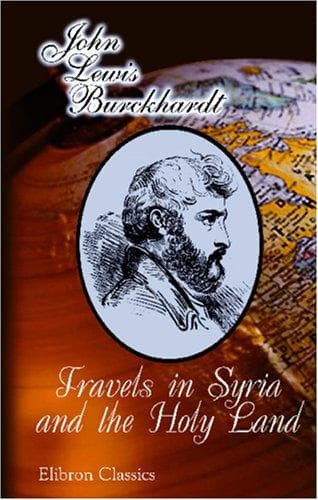
Travels in Syria and the Holy LandBurckhardt, John Lewis
History
Travels in Syria and the Holy Land
Burckhardt, John Lewis
Palestine -- Description and travel; Syria -- Description and travel
Pashas were careful also not to permit any one to become too powerful;
the princes of the reigning family were continually changed; and party
spirit was revived in the mountain whenever the interests of the Porte
required it. About eighty years ago the country was divided into the two
great parties of Keisy [Arabic], whose banner was red, and Yemeny
[Arabic], whose banner was white, and the whole Christian population
[p.196]ranged itself on the one side or the other. The Keisy gained at
length the entire ascendancy, after which none but secret adherents of
the Yemeny remained, and the name itself was forgotten. Then arose the
three sects of Djonbelat, Yezbeky, and Neked. These still exist; thirty
years ago the two first were equal, but the Djonbelat have now got the
upper hand, and have succeeded in disuniting the Yezbeky and Neked.
The Djonbelat [Arabic] draw their origin from the Druse mountain of
Djebel Aala, between Ladakie and Aleppo: they are an old and noble
family, and, in the seventeenth century, one of their ancestors was
Pasha of Aleppo; it forms at present the richest and most numerous
family, and the strongest party in the mountain.
The Yezbeky [Arabic], or as they are also called, El Aemad [Arabic], are
few in number, but are reputed men of great courage and enterprize.
Their principal residence is in the district of El Barouk, between Deir
el Kammar and Zahle.
The Neked, whose principal Sheikh is at present named Soleiman, inhabit,
for the greater part, Deir el Kammar; seven of their principal chiefs
were put to death thirteen years ago in the serai of the Emir Beshir,
and a few only of their children escaped the massacre; these have now
attained to years of manhood, and remain at Deir el Kammar, watched by
the Djonbelaty and the Aemad, who are united against them.
The Djonbelat now carry every thing with a high hand; their chief, El
Sheikh Beshir is the richest and the shrewdest man in the mountain;
besides his personal property, which is very considerable, no affair of
consequence is concluded without his interest being courted, and dearly
paid for. His annual income amounts to about two thousand purses, or
fifty thousand pounds sterling. The whole province of Shouf is under his
command, and he is in partnership
Public-domain text, read in full here on John Shaqi.
Reviews
Reviews
No reviews yet
Be the first to share your thoughts on this work.
Elsewhere in the archive
Join the Discussion
Join the discussion
Sign in to leave a comment or review.
Sign InorCreate an account