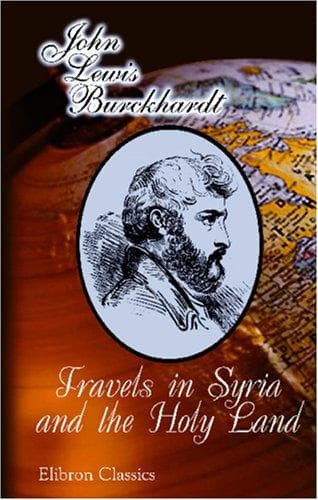
Travels in Syria and the Holy LandBurckhardt, John Lewis
History
Travels in Syria and the Holy Land
Burckhardt, John Lewis
Palestine -- Description and travel; Syria -- Description and travel
[p.197] with almost all the Druses who possess landed property there.
The greater part of the district of Djesn [Arabic] is his own property,
and he permits no one to obtain possesions in that quarter, while he
increases his own estates yearly, and thus continually augments his
power. The Emir Beshir can do nothing important without the consent of
the Sheikh Beshir, with whom he is obliged to share all the
contributions which he extorts from the mountaineers. It is from this
cause that while some parts of the mountain are very heavily taxed, in
others little is paid. The Druses form the richest portion of the
population, but they supply little to the public contributions, being
protected by the Sheikh Beshir. It will be asked, perhaps, why the
Sheikh does not set aside the Emir Beshir and take the ostensible power
into his own hands? Many persons believe that he entertains some such
design, while others, better informed perhaps, assert that the Sheikh
will never make the attempt, because he knows that the mountaineers
would never submit to a Druse chief. The Druses are certainly in a
better condition at present than they would be under the absolute sway
of the Sheikh, who would soon begin to oppress instead of protecting
them, as he now does; and the Christians, who are a warlike people,
detest the name of Druse too much ever to yield quietly to a chief of
that community. It is, probably, in the view of attaching the Christians
more closely to him, and to oppose them in some measure to the Druses,
that the Emir Beshir, with his whole family, has secretly embraced the
christian religion. The Shehab, as I have already mentioned, were
formerly members of the true Mussulman faith, and they never have had
among them any followers of the doctrines of the Druses. They still
affect publicly to observe the Mohammedan rites, they profess to fast
during the Ramadhan, and the Pashas still treat them as Turks; but it is
no longer matter of doubt, that the greater part of the Shehab, with
[p.198] the Emir Beshir at their head, have really embraced that branch
only of the family which governs at Rasheya and Hasbeya continue in the
religion of their ancestors.
Public-domain text, read in full here on John Shaqi.
Reviews
Reviews
No reviews yet
Be the first to share your thoughts on this work.
Elsewhere in the archive
Join the Discussion
Join the discussion
Sign in to leave a comment or review.
Sign InorCreate an account