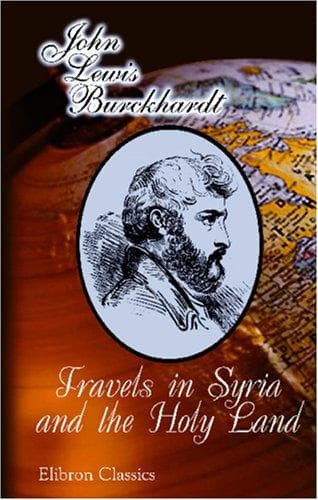
Travels in Syria and the Holy LandBurckhardt, John Lewis
History
Travels in Syria and the Holy Land
Burckhardt, John Lewis
Palestine -- Description and travel; Syria -- Description and travel
[p.202] conduct is so frequent, that a father never allows a full grown
son to remain alone with any of the females of his family. Their own
religion allows them to take their sisters in marriage; but they are
restrained from indulging in this connexion, on account of its
repugnance to the Mohammedan laws. A Druse seldom has more than one
wife, but he divorces her under the slightest pretext; and it is a
custom among them, that if a wife asks her husband's permission to go
out, and he says to her "Go;" without adding "and come back," she is
thereby divorced; nor can her husband recover her, even though it should
be their mutual wish, till she is married again according to the Turkish
forms, and divorced from her second husband. It is known that the
Druses, like all Levantines, are very jealous of their wives; adultery,
however, is rarely punished with death; if a wife is detected in it, she
is divorced; but the husband is afraid to kill her seducer, because his
death would be revenged, for the Druses are inexorable with respect to
the law of retaliation of blood; they know too that if the affair were
to become public, the governor would ruin both parties by his
extortions. Unnatural propensities are very common amongst them.
The Akal are those who are supposed to know the doctrines of the Druse
religion; they superintend divine worship in the chapels or, as they are
called, Khaloue [Arabic], and they instruct the children in a kind of
catechism. They are obliged to abstain from swearing, and all abusive
language, and dare not wear any article of gold or silk in their dress.
Many of them make it a rule never to eat of any food, nor to receive any
money, which they suspect to have been improperly acquired. For this
reason, whenever they have to receive considerable sums of money, they
take care that it shall be first exchanged for other coin. The Sheikh El
Nedjem, who generally accompanies the Sheikh Beshir, in his visits to
the Emir, never tastes
[p.203] food in the palace of the latter, nor even smokes a pipe there,
always asserting that whatever the Emir possesses has been unlawfully
obtained. There are different degrees of Akal, and women are also
admitted into the order, a privilege which many avail themselves of,
from parsimony, as they are thus exempted from wearing the expensive
head-dress and rich silks fashionable among them.
A father cannot entirely disinherit his son, in that case his will would
be set aside; but he may leave him a single mulberry tree for his
portion. There is a Druse Kadhi at Deir el Kammar, who judges according
to the Turkish laws, and the customs of the Druses; his office is
hereditary in a Druse family; but he is held in little repute, as all
causes of importance are carried before the Emir or the Sheikh Beshir.
The Druses do not circumcise their children; circumcision is practised
only in the mountain by those members of the Shehab family who continue
to be Mohammedans.
Public-domain text, read in full here on John Shaqi.
Reviews
Reviews
No reviews yet
Be the first to share your thoughts on this work.
Elsewhere in the archive
Join the Discussion
Join the discussion
Sign in to leave a comment or review.
Sign InorCreate an account