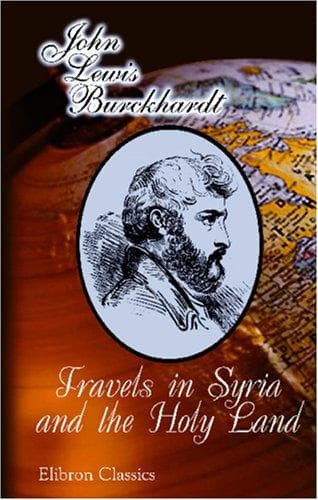
Travels in Syria and the Holy LandBurckhardt, John Lewis
History
Travels in Syria and the Holy Land
Burckhardt, John Lewis
Palestine -- Description and travel; Syria -- Description and travel
The best feature in the Druse character is that peculiar law of
hospitality, which forbids them ever to betray a guest. I made
particular enquiries on this subject, and I am satisfied that no
consideration of interest or dread of power will induce a Druse to give
up a person who has once placed himself under his protection. Persons
from all parts of Syria are in the constant practice of taking refuge in
the mountain, where they are in perfect security from the moment they
enter upon the Emir's territory; should the prince ever be tempted by
large offers to consent to give up a refugee, the whole country would
rise, to prevent such a stain upon their national reputation. The mighty
Djezzar, who had invested his own creatures with the government of the
mountain, never could force them to give up a single individual of all
those who fled thither from his tyranny. Whenever he became
[p.204] very urgent in his demands, the Emir informed the fugitive of
his danger, and advised him to conceal himself for a time in some more
distant part of his territory; an answer was then returned to Djezzar
that the object of his resentment had fled. The asylum which is thus
afforded by the mountain is one of the greatest advantages that the
inhabitants of Syria enjoy over those in the other parts of the Turkish
dominions.
The Druses are extremely fond of raw meat; whenever a sheep is killed,
the raw liver, heart, &c. are considered dainties; the Christians follow
their example, but with the addition of a glass of brandy with every
slice of meat. In many parts of Syria I have seen the common people eat
raw meat in their favourite dish the Kobbes; the women, especially,
indulge in this luxury.
Mr. Barker told me that during his two years residence at Harissa and in
the mountain, he never heard any kind of music. The Christians are too
devout to occupy themselves with such worldly pleasures, and the Druses
have no sort of musical instruments.
The Druses have a few historical books which mention their nation; Ibn
Shebat, for instance, as I was told, gives in his history of the
Califes, that of the Druses also, and of the family of Shehab. Emir
Haidar, a relation of the Emir Beshir, has lately begun to compile a
history of the Shehabs, which already forms a thick quarto volume.
I believe that the greatest amount of the military forces of the Druses
is between ten and fifteen thousand firelocks; the Christians of the
mountain may, perhaps, be double that number; but I conceive that the
most potent Pasha or Emir would never be able to collect more than
twenty thousand men from the mountain.
The districts inhabited by Druses in the Pashalik of Saida are the
following. El Tefahh, of which one half belongs to the
Public-domain text, read in full here on John Shaqi.
Reviews
Reviews
No reviews yet
Be the first to share your thoughts on this work.
Elsewhere in the archive
Join the Discussion
Join the discussion
Sign in to leave a comment or review.
Sign InorCreate an account