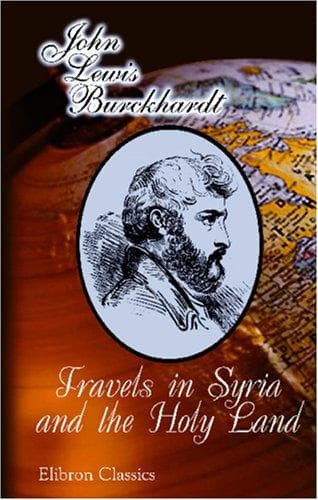
Travels in Syria and the Holy LandBurckhardt, John Lewis
History
Travels in Syria and the Holy Land
Burckhardt, John Lewis
Palestine -- Description and travel; Syria -- Description and travel
[p.273]and Wady Sheriat. In Djebel Adjeloun, Moerad, and Beni Obeid,
none of the basalt or black stone is met with; but in some parts of El
Kefarat, in our way from Hebras to Om Keis, I saw alternate layers of
calcareous and basaltic rock, with thin strata of flint. The habitations
of Om Keis are, for the greater part, caverns. There is no water but
what is collected in reservoirs during rains; these were quite dried up,
which was the occasion, perhaps, of the place having been abandoned, for
we found not a single inhabitant.
My guide being ignorant of the road to Feik, wished to return to Hebras;
and I was hesitating what to do, when we were met by some peasants of
Remtha, in the Haouran, who were in their way to the Ghor, to purchase
new barley, of which grain the harvest had already begun in the hot
climate of that valley. I joined their little caravan. We continued, for
about half an hour from Om Keis, upon the high plain, and then descended
the mountains, the western declivity of which is entirely basaltic. At
the end of two hours from Om Keis, we reached the banks of the Sheriat
el Mandhour, or Sheriat el Menadhere (Arabic] or Arabic) which we passed
at a ford. This river takes the additional name of the Arabs who live
upon its banks, to distinguish it from the Sheriat el Kebir (Great
Sheriat), by which the Jordan is known. The Sheriat el Menadhere is
formed by the united streams of the Nahr Rokad [Arabic], which flows
from near Ain Shakhab, through the eastern parts of Djolan; of the
Hereir, whose source is in the swampy ground near Tel Dilly, on the Hadj
route, between Shemskein and El Szannamein: of the Budje, which comes
from Mezareib, and after its junction with the Hereir, is called Aweired
[Arabic], and of the Wady Hamy Sakkar, besides several other smaller
Wadys. The name of Sheriat, is first applied to the united streams near
Szamme. From thence it flows in a deep bed of tufwacke; and its banks
are cultivated by the Arabs Menadhere (sing. Mandhour), who live under
VALLEY OF THE GHOR.
Public-domain text, read in full here on John Shaqi.
Reviews
Reviews
No reviews yet
Be the first to share your thoughts on this work.
Elsewhere in the archive
Join the Discussion
Join the discussion
Sign in to leave a comment or review.
Sign InorCreate an account