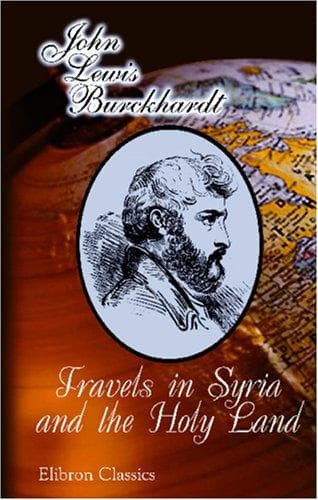
Travels in Syria and the Holy LandBurckhardt, John Lewis
History
Travels in Syria and the Holy Land
Burckhardt, John Lewis
Palestine -- Description and travel; Syria -- Description and travel
Among the Fellahs of the Haouran, the richest lives like the poorest,
and displays his superior wealth only on the arrival of strangers. The
ancient buildings afford spacious and convenient dwellings to many of
the modern inhabitants, and those who occupy them may have three or four
rooms for each family; but in newly built villages, the whole family,
with all its household furniture, cooking utensils, and provision
chests, is commonly huddled together in one apartment. Here also they
keep their wheat and barley in reservoirs formed of clay, called Kawara
[Arabic], which are about five feet high and two feet in diameter. The
chief articles
[p.293]of furniture are, a handmill, which is used in summer, when there
is no water in the Wadys to drive the mills; some copper kettles; and a
few mats; in the richer houses some woollen Lebaet are met with, which
are coarse woollen stuffs used for carpets, and in winter for horse-
cloths: real carpets or mattrasses are seldom seen, unless it be upon
the arrival of strangers of consequence. Their goat's hair sacks, and
horse and camel equipments, are of the same kind as those used by the
Bedouins, and are known by the same names. Each family has a large
earthen jar, of the manufacture of Rasheiat el Fukhar, which is filled
every morning by the females, from the Birket or spring, with water for
the day's consumption. In every house there is a room for the reception
of strangers, called from this circumstance Medhafe; it is usually that
in which the male part of the family sleeps; in the midst of it is a
fire place to boil coffee.
The most common dishes of these people are Burgoul and Keshk; in summer
they supply the place of the latter by milk, Leben, and fresh butter. Of
the Burgoul I have spoken on other occasions; there are two kinds of
Keshk, Keshk-hammer and Keskh-leben; the first is prepared by putting
leaven into the Burgoul, and pouring water over it; it is then left
until almost putrid, and afterwards spread out in the sun, to dry; after
which it is pounded, and when called for, served up mixed with oil, or
butter. The Keskh-leben is prepared by putting Leben into the Burgoul,
instead of leaven; in other respects the process is the same. Keskh and
bread are the common breakfast, and towards sunset a plate of Burgoul,
or some Arab dish, forms the dinner; in honour of strangers, it is usual
to serve up at breakfast melted butter and bread, or fried eggs, and in
the evening a fowl boiled in Burgoul, or a kid or lamb; but this does
not very often happen. The women and children eat up whatever the men
have left on
[p.294] their plates. The women dress in the Bedouin manner; they have a
veil over the head, but seldom veil their faces.
Public-domain text, read in full here on John Shaqi.
Reviews
Reviews
No reviews yet
Be the first to share your thoughts on this work.
Elsewhere in the archive
Join the Discussion
Join the discussion
Sign in to leave a comment or review.
Sign InorCreate an account