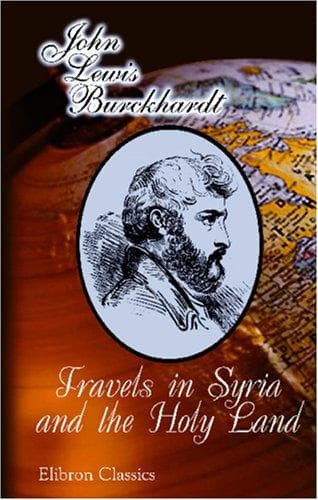
Travels in Syria and the Holy LandBurckhardt, John Lewis
History
Travels in Syria and the Holy Land
Burckhardt, John Lewis
Palestine -- Description and travel; Syria -- Description and travel
[p.iv]It appears unnecessary to the Editor to enter into any lengthened
discussion in justification of the ancient names which he has inserted
in the maps; he thinks it sufficient to refer to the copious exposition
of the evidences of Sacred Geography contained in the celebrated work of
Reland. Much is still wanting to complete this most interesting
geographical comparison; and as a great part of the country visited by
Burckhardt has since his time been explored by a gentleman better
qualified to illustrate its antiquities by his learning; who travelled
under more favourable circumstances, and who was particuarly diligent in
collecting those most faithful of all geographical evidences, ancient
inscriptions, it may be left to Mr. W. Bankes, to illustrate more fully
the ancient geography of the Decapolis and adjoining districts, and to
remove some of the difficulties arising from the ambiguity of the
ancient authorities.
It will be found, perhaps, that our traveller is incorrect in supposing,
that the ruins at Omkeis are those of Gamala, for the situalion of
Omkeis, the strength of its position, and the extent of the ruins, all
favour the opinion that it was Gadara, the chief city of Peraea, the
strongest place in this part of the country, and the situation of which,
on a mountain over against Tiberias and Scythopolis, [Polyb.1.5.c.71.
Joseph.de Bel. Jud.l.4.c.8. Euseb. Onomast. in [Greek text]. The
distance of the ruins at Omkeis from the Hieromax and the hot baths
seems to have been Burckhardt's objection to their being the remains of
Gadara; but this distance is justified by St. Jerom, by Eusebius, and by
a writer of the 5th century. According to the two former authors the hot
baths were not at Gadara, but at a place near it called Aitham, or
Aimath, or Emmatha; and the latter correctly states the distance at five
miles. Reland Palaest. p.302, 775. Perhaps Gamala was at El Hosn;
Gaulanitis, of which Gamala was the chief town, will then correspond
very well with Djolan.] corresponds precisely with that of Omkeis. But
it will probably be admitted, that our traveller has rightly placed
several other cities, such as Scythopolis, Hippus, Abila,[There were two
cities of this name. Abil on the Western borders of the Haouran appears
to have been the Abila of Lysanias, which the Emperors Claudius and Nero
gave together with Batanaea and Trachonitis, to Herodes Agrippa. Joseph.
Ant. Jud. l.19.c.5.--sl.20.c.7.] Gerasa, Amathus;
[p.v]and he has greatly improved our knowledge of Sacred Geography, by
ascertaining many of the Hebrew sites in the once populous but now
deserted region, formerly known by the names of Edom, Moab, Ammon, and
the country of the Amorites.
Public-domain text, read in full here on John Shaqi.
Reviews
Reviews
No reviews yet
Be the first to share your thoughts on this work.
Join the Discussion
Join the discussion
Sign in to leave a comment or review.
Sign InorCreate an account