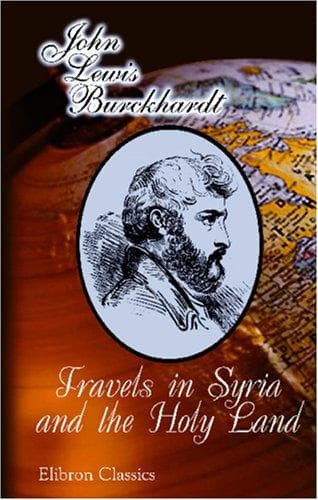
Travels in Syria and the Holy LandBurckhardt, John Lewis
History
Travels in Syria and the Holy Land
Burckhardt, John Lewis
Palestine -- Description and travel; Syria -- Description and travel
The greater part of the fertile plain of the Houle is uncultivated; the
Arabs El Faddel, El Naim, and the Turkmans pasture their cattle here. It
is watered by the river of Hasbeya, the Jordan, and the river of Banias,
besides several rivulets which descend from the mountains on its eastern
side. The source of the Jordan, or as it is here called, Dhan [Arabic],
is at an hour and a quarter N.E. from Banias. It is in the plain, near a
hill called Tel-el-Kadi. There are two springs near each other, one
smaller than the other, whose waters unite immediately below. Both
sources are on level ground, amongst rocks of tufwacke. The larger
source immediately forms a river twelve or fifteen yards across, which
rushes rapidly over a stony bed into the lower plain. There are no ruins
of any kind near the springs; but the hill over them seems to have been
built upon, though nothing now is visible. At a quarter of an hour to
the N. of the spring are ruins of ancient habitations, built of the
black tufwacke, the principal rock found in the plain. The few houses at
present inhabited on that spot are called Enkeil.
BANIAS.
[p.43]I was told that the ancient name of the river of Banias was Djour,
which added to the name of Dhan, made Jourdan; the more correct
etymology is probably Or Dhan, in Hebrew the river of Dhan. Lower down,
between the Houle and the lake Tabaria, it is called Orden by the
inhabitants; to the southward of the lake of Tabaria it bears the name
of Sherya, till it falls into the Dead Sea.
October 15th.--My guide returned to Zahle. It was my intention to take a
view of the lake and its eastern borders; but a tumour, which threatened
to prevent both riding and walking, obliged me to proceed immediately to
Damascus. I had reason to congratulate myself on the determination, for
if I had staid a day longer, I should have been compelled to await my
recovery at some village on the road. Add to this, I had only the value
of four shillings left, after paying my guide: this alone, however,
should not have prevented me from proceeding, as I knew that two days
were sufficient to enable me to gratify my curiosity, and a guide would
have thought himself well paid at two shillings a day; as to the other
expenses, travelling in the manner of the country people rendered money
quite unnecessary.
Public-domain text, read in full here on John Shaqi.
Reviews
Reviews
No reviews yet
Be the first to share your thoughts on this work.
Join the Discussion
Join the discussion
Sign in to leave a comment or review.
Sign InorCreate an account