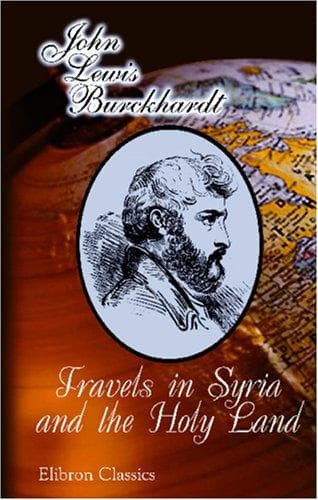
Travels in Syria and the Holy LandBurckhardt, John Lewis
History
Travels in Syria and the Holy Land
Burckhardt, John Lewis
Palestine -- Description and travel; Syria -- Description and travel
The Ledja, which is from two to three days journey in length, by one in
breadth, is inhabited by several tribes of Arabs; viz. Selman [Arabic],
Medledj [Arabic], Szolout [Arabic], Dhouhere [Arabic], and Siale
[Arabic]; of these the Szolout may have about one hundred tents, the
Medledj one hundred and twenty, and the others fifty or sixty. They
breed a vast number of goats, which easily find pasturage amongst the
rocks; a few of them also keep sheep and cows, and cultivate the soil in
some parts of the Ledja, where they sow wheat and barley. They possess
few horses; the Medledj have about twenty, and the Szolout and Dhouhere
each a dozen. But I shall have occasion to speak of these Arabs again in
describing the people of the country.
The tent in which we slept was remarkably large, although it could not
easily be perceived amidst the labyrinth of rocks where it was pitched;
yet our host was kept awake the whole night by
THE LEDJA.
[p.112]the fear of robbers, and the dogs barked incessantly. He told me
next morning that the Szolout had lately been very successful in their
nightly depredations upon the Medledj. Our host having no barley, gave
my horse a part of some wheat which he had just brought from the plain,
to bake into bread for his family.
December lst.--We departed at sunrise, the night having been so cold
that none of us was able to sleep. We found our way with great
difficulty out of the labyrinth of rocks which form the inner Ledja, and
through which the Arabs alone have the clue. Some of the rocks are
twenty feet high, and the country is full of hills and Wadys. In the
outer Ledja trees are less frequent than here, where they grow in great
numbers among the rocks; the most common are the oak, the Malloula, and
the Bouttan; the latter is the bitter almond, from the fruit of which an
oil is extracted used by the people of the country to anoint their
temples and forehead as a cure for colds; its branches are in great
demand for pipe tubes. There are no springs in any part of this stony
district, but water collects, in winter time, in great quantities in the
Wadys, and in the cisterns and Birkets which are every where met with;
in some of these it is kept the whole summer; when they are dried up the
Arabs approach the borders of the Ledja, called the Loehf, to water
their cattle at the springs in that district. The camel is met with
throughout the Ledja, and walks with a firm step over the rocky surface.
In summer he feeds on the flowers or dry grass of the pasturing places.
In the interior parts of the Ledja the rocks are in many places cleft
asunder, so that the whole hill appears shivered and in the act of
falling down: the layers are generally horizontal, from six to eight
feet, or more, in thickness, sometimes covering the hills, and inclining
to their curve, as appears from the fissures, which often traverse the
rock from top to bottom. In
Public-domain text, read in full here on John Shaqi.
Reviews
Reviews
No reviews yet
Be the first to share your thoughts on this work.
Elsewhere in the archive
Join the Discussion
Join the discussion
Sign in to leave a comment or review.
Sign InorCreate an account