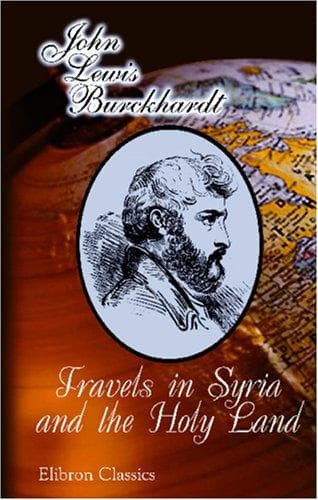
Travels in Syria and the Holy LandBurckhardt, John Lewis
History
Travels in Syria and the Holy Land
Burckhardt, John Lewis
Palestine -- Description and travel; Syria -- Description and travel
[p.113] many places are ruined walls; from whence it may be conjectured
that a stratum of soil of sufficient depth for cultivation had in
ancient times covered the rock.
We had lost our road, when we met with a travelling encampment of
Medledj, who guided us into a more open place, where their companions
were pitching their tents. We breakfasted with them, and I was present
during an interesting conversation between one of my Druse companions
and an Arab. The wife of the latter, it appeared, had been carried off
by another Arab, who fearing the vengeance of the injured husband, had
gone to the Druse Sheikh of Khabeb, and having secured his Dakhil
[Arabic], or protection, returned to the woman in the Ledja. The Sheikh
sent word to the husband, cautioning him against taking any violent
measures against his enemy. The husband, whom we here met with, wished
to persuade the Druses that the Dakhil of the Sheikh was unjust, and
that the adulterer ought to be left to his punishment. The Druse not
agreeing with him, he swore that nothing should prevent him from
shedding the blood of the man who had bereft him of his own blood; but I
was persuaded that he would not venture to carry his threat into effect;
for should he kill his enemy, the Druses would not fail to be revenged
upon the slayer or his family.
The outer Ledja is to be distinguished from the inner, on this side as
well as on that by which we entered it, the former being much less
rocky, and more fit for pasturage than the latter. On the borders of the
inner Ledja we passed several places where the mill-stones are made,
which I have mentioned in a former part of my journal. The stones are
cut horizontally out of the rocks, leaving holes of four or five feet in
depth, and as many in circumference; fifty or sixty of these excavations
are often met with in the circumference of a mile. The stones are
carried to be finished at Ezra, Mehadje, Aeib, Khabeb, and Shaara.
SHAARA.
[p.114] In one hour and a half from the borders of the Ledja, we came to
Kastal Kereim, a ruined village, with a Birket; half an hour from it,
Kereim, a Druse village. Between Kereim and Khabeb in the Loehf, is Aeib
[Arabic], a Druse village, in which is a powder manufactory; there is
another at Khabeb. Half an hour from Kereim is Kalaat Szamma [Arabic], a
ruined village, with several towers. One hour and a half, Shaara, a
village inhabited by about one hundred Druse and Christian families. We
travelled this day about eight hours and a half. Shaara was once a
considerable city; it is built on both sides of a Wady, half an hour
from the cultivated plain, and is surrounded by a most dreary barren
War. It has several large solidly built structures, now in ruins, and
amongst others a tower that must have been about forty-five feet high.
In the upper town is an ancient edifice with arches, converted into a
mosque: over its door is this inscription:
[Greek].
Public-domain text, read in full here on John Shaqi.
Reviews
Reviews
No reviews yet
Be the first to share your thoughts on this work.
Elsewhere in the archive
Join the Discussion
Join the discussion
Sign in to leave a comment or review.
Sign InorCreate an account