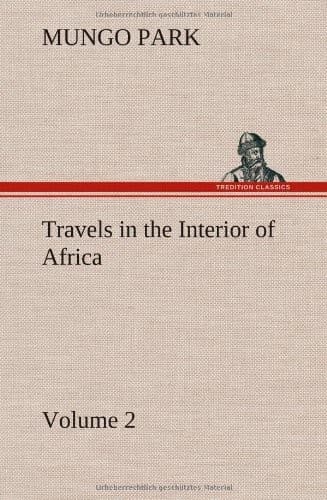
Travels in the Interior of Africa — Volume 02Park, Mungo
History
Travels in the Interior of Africa — Volume 02
Park, Mungo
Africa -- Discovery and exploration; Niger River
And left to perish for thy country’s crime,
Or destined still, when all thy wanderings cease,
On Albion’s lovely lap to rest in peace,
Pilgrim! in heaven or earth, where’er thou be,
Angels of mercy guide and comfort thee!
A note to the same poem gives the following record of facts,
substantiated in a court of justice, in which there can be only one
answer to the question, “Which were the savages?”
“In this year (1783) certain underwriters desired to be heard against
Gregson and others of Liverpool, in the case of the ship _Zong_,
Captain Collingwood, alleging that the captain and officers of the
said vessel threw overboard one hundred and thirty-two slaves alive
into the sea, in order to defraud them by claiming the value of the
said slaves, as if they had been lost in a natural way. In the
course of the trial which afterwards came on, it appeared that the
slaves on board the _Zong_ were very sickly; that sixty of them had
already died, and several were ill and likely to die, when the
captain proposed to James Kelsal, the mate, and others to throw
several of them overboard, stating that ‘if they died a natural
death, the loss would fall upon the owners of the ship, but that if
they were thrown into the sea, it would fall upon the underwriters.’
He selected accordingly one hundred and thirty-two of the most sickly
of the slaves. Fifty-four of these were immediately thrown
overboard, and forty-two were made to be partakers of their fate on
the succeeding day. In the course of three days afterwards the
remaining twenty-six were brought upon deck to complete the number of
victims. The first sixteen submitted to be thrown into the sea, but
the rest, with a noble resolution, would not suffer the offices to
touch them, but leaped after their companions and shared their fate.
“The plea which was set up in behalf of this atrocious and
unparalleled act of wickedness was that the captain discovered, when
he made the proposal, that he had only two hundred gallons of water
on board, and that he had missed his port. It was proved, however,
in answer to this, that no one had been put upon short allowance; and
that, as if Providence had determined to afford an unequivocal proof
of the guilt, a shower of rain fell, and continued for three days,
immediately after the second lot of slaves had been destroyed, by
means of which they might have filled many of their vessels with
water, and thus have prevented all necessity for the destruction of
the third.
Public-domain text, read in full here on John Shaqi.
Reviews
Reviews
No reviews yet
Be the first to share your thoughts on this work.
Elsewhere in the archive
Join the Discussion
Join the discussion
Sign in to leave a comment or review.
Sign InorCreate an account