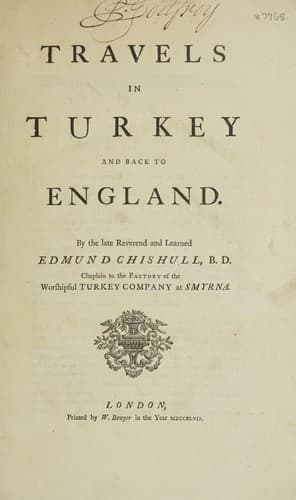
Travels in Turkey and back to EnglandChishull, Edmund
History
Travels in Turkey and back to England
Chishull, Edmund
Turkey -- Description and travel -- Early works to 1800
Before the cool of the evening we visited the ruins of this once
flourishing city; and towards the western part observed the standing
walls of two or three spatious and lofty rooms, not unworthy the palace
of the ancient kings of _Lydia_. They were all arched towards the
foundation, and adorned as well as strengthened at each corner with hewn
stone; but the main part of the fabric consisted of a broad and durable
brick, which is likewise observable in most of the ancient ruins of
_Asia Minor_. From hence we passed thro heaps of rubbish, and tracks of
continued foundations, to the eastern part of the city; where stand the
pillars and front of another spatious building, the figure and situation
of which persuaded us, that they were the remains of the cathedral
church. A little southerly from hence we viewed the full extent of
another stately room, which however antient it might be, was nevertheless
raised out of ruins more antient than itself; as appeared from several
rich pillars, and architraves, confusedly placed among the rubbish of
the walls. About the distance of a furlong, full south of the antient
city, are to be seen the beautiful remains not of an amphitheatre, as
has been supposed, but rather of some royal palace. Here we observed six
lofty Ionic pillars, all of them still intire, except that the capital
of one is distorted by an earthquake. There adjoins to them a fair and
magnificent portal, the pilasters of which, being about twenty feet
high, and twelve feet distant from each other, are joined at the top by
one entire stone, which, by what art or force it was there erected, is
difficult to conceive; for tho _Pliny_[29] pretends to account for the
like difficulty in the architecture of the temple of _Ephesus_, yet that
passage gives but little satisfaction in the matter. There occurs nothing
else, that is remarkable about _Sardis_, besides the broken walls of the
castle on an adjoining hill; the ascent and prospect of which, however
magnified by Sir _Paul Rycaut_, we yet thought so inferior, to what we
lately had found at _Magnesia_, that it could not raise our curiosity
to undertake the climbing of that precipice, especially since we could
promise ourselves the same prospect to a greater advantage from the top
of _Tmolus_; and as for two or three broken inscriptions, which are
there extant, we were content to peruse them in Dr. _Smith’s_ printed
_Journal_[30].
April xxviii.
Public-domain text, read in full here on John Shaqi.
Reviews
Reviews
No reviews yet
Be the first to share your thoughts on this work.
Join the Discussion
Join the discussion
Sign in to leave a comment or review.
Sign InorCreate an account