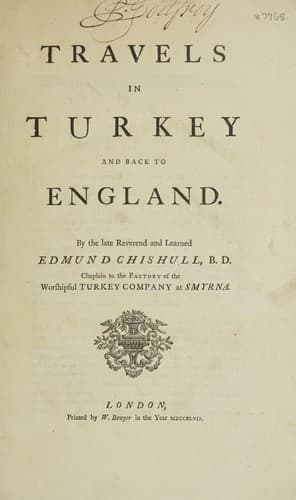
Travels in Turkey and back to EnglandChishull, Edmund
History
Travels in Turkey and back to England
Chishull, Edmund
Turkey -- Description and travel -- Early works to 1800
Soon after eleven a clock we arrived at _Tyria_, and _conácked_ in an
old, dirty, ruinous _kane_; having by this time learnt, that the weary
and thirsty traveler must repine at no reception, which he meets with in
Turkey. _Tyria_ yeilds a pleasant prospect, as we ride into the city,
gently ascending from the adjacent plain. The buildings are curiously
intermixt with trees and gardens, which extend the circuit of the place;
tho the number of its houses seems inferior to that of _Smyrna_. We
counted about fourteen _mosques_, one of which we observed to be royal,
that is, adorned with a double _minarée_. Having entered the town we
found the streets negligently kept, and meanly built; but at the same
time populous enough, not without the appearance of a considerable trade.
It is to be wondered that so large a city, standing in the very heart of
Asia, should have no remains of antiquity[37]. There are indeed two Greek
churches in the place, where the poor ignorant priests would persuade
both themselves and us, that this was the antient _Thyatira_; but we
thought it not fit to rob them of the satisfaction of this error, nor
puzzle them with any accounts of antient geography, or late experience,
that evince the contrary.
It is pretended in some journals, that two or three valuable inscriptions
are to be found in these churches, tho we were now eye witnesses of
the contrary; for there occur’d nothing in that, which they call the
Metropolitan church, but a defaced monument, whereon no intelligible
words were to be read, except ΧΡΗΣΤΕ ΧΑΙΡΕ. Over the entrance of the
other there is a piece of devotion, written in modern characters: but
more remarkable, in the body of the wall stands a large image of our
_Savior_, elegantly carved in porphyry; tho it now appears rudely
mangled, and seems to have felt the fury of the old angry _iconoclastae_.
In the hand is portrayed an open book, inscribed with this sentence
out of _St. John’s_ Gospel, viii. 12. Ἐγώ εἰμι τὸ φῶς τοῦ κόσμου. This
was an instance, which may perhaps appear to be singular, at least
it is contrary to the general practice, as well as persuasion of the
Greek church; for tho they have a superstitious fondness for religious
pictures, yet they abhor all imagery in _relievo_, and look upon it as
inclining to heathenism and idolatry.
April xxx.
By six this morning we set forward from _Tyria_ in our way for _Ephesus_,
and passing thro the extreme skirt of the city, we observe the
inscription of an ancient stone coffin, now converted by the Turks to
supply the use of a cistern. It has been defaced towards the upper parts
of the chest, and permitted us to read only these following words:
Public-domain text, read in full here on John Shaqi.
Reviews
Reviews
No reviews yet
Be the first to share your thoughts on this work.
Join the Discussion
Join the discussion
Sign in to leave a comment or review.
Sign InorCreate an account