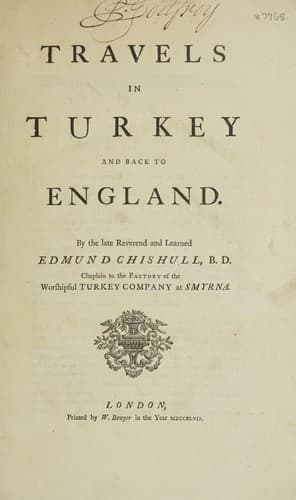
Travels in Turkey and back to England — John Shaqi
Travels in Turkey and back to EnglandChishull, Edmund
History
Travels in Turkey and back to England
Chishull, Edmund
Turkey -- Description and travel -- Early works to 1800
The first temple had been burnt on the same night, in which _Alexander
the Great_ was born; and this second was then rebuilding, when that
prince was residing at _Ephesus_, and pursuing his conquests in _Asia
Minor_. He contributed sumptuously to the expence, and afterwards
proposed to reimburse the whole, if the Ephesians would consent to
inscribe his name upon the fabric[49]. But those citizens had an ambition
equal to that of Alexander, and therefore diverted his desires by a
fulsom compliment, and the dedication of a famous picture; which was
Alexander himself armed with thunder, designed by the inimitable Apelles,
and valued at twenty talents of gold[50]. _Pliny_ has likewise told us,
that this temple was adorned with an hundred and twenty seven pillars,
each sixty feet high, thirty six of which were carved, and that by the
celebrated hand of _Scopas_. The whole structure was four hundred and
twenty five feet in length, and two hundred and twenty feet in breadth;
and was founded in this watry ground, out of a vain hope to secure it by
that means against time and earthquakes.
These are the most remarkable curiosities either of Turkish, Christian,
or Heathen antiquity, which in the space of this afternoon we observed at
_Ephesus_. Besides which we viewed many intire pillars of an aqueduct,
that passes over the plain from the southern hills; as also in two places
the uncertain footsteps of a theatre; and without the new castle a full
face[51], with two serpents (cut on a stone) whose heads meet over it,
and their bodies descend on each side. This monument is supposed to
represent _Diana_, in the two characters of _Luna_ and _Proserpine_.
But it is to be wished, that some curious traveler might remain two or
three days at _Ephesus_; during which time by removing the weeds, and
clearing the confused ruins, he might possibly discover many valuable
inscriptions; as by the benefit of a ladder he might take one or two from
the wall above mentioned under the Christian ruins, which to our great
dissatisfaction we found not legible from the ground.
Among the few imperfect inscriptions discoverable in so short a stay,
the name of P. VEDIVS ABOSCANTVS, with mention of his wife and daughter,
is once or twice repeated both in Greek and Latin. And ΑΤΤΙΚΟΝ ΗΡΩΔΗΝ,
or the name of that ingenious Roman, whose part is so entertaining in
the _Noctes Atticae_ of _Gellius_, is preserved on a fragment among the
pillars of the aqueduct. In the same place is frequent mention of _M.
Antoninus_, once particularly on occasion of an honour done by the city
to his daughter _Fadilla_.
ΦΑΔΙΛΛΑΝ ΘΥΓΑΤΕΡΑ Μ. ΑΥΡΗΛΙΟΥ ΑΝΤΩΝΕΙΝΟΥ
ΚΑΙΣΑΡΟΣ ΣΕΒΑΣΤΟΥ[52]
This distich likewise on the castle gate is remarkable for the word
_Ptelea_, an old name of _Ephesus_, which occurs in it.
ΤΟΥΤΟΝ ΟΝ ΕΙΣΟΡΑΑΣ ΤΥΠΟΝ ΟΡΘΙΟΝ ΑΝΤΩΝΙΝΟΥ
ΔΩΡΟΘΕΟΣ ΠΤΕΛΕΗ ΘΗΚΑΤΟ ΚΡΥΠΤΟΜΕΝΟΝ
Public-domain text, read in full here on John Shaqi.
Reviews
Reviews
No reviews yet
Be the first to share your thoughts on this work.
Join the Discussion
Join the discussion
Sign in to leave a comment or review.
Sign InorCreate an account