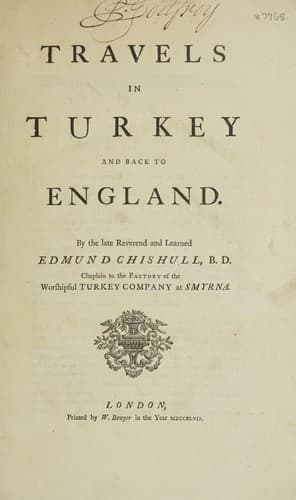
Travels in Turkey and back to EnglandChishull, Edmund
History
Travels in Turkey and back to England
Chishull, Edmund
Turkey -- Description and travel -- Early works to 1800
As to the temper and disposition of the inhabitants, they appear cordial
and hospitable, drink almost continually, and eat plentifully, are
unpolite but importunate in their civility, and even the vulgar sort
usually speak Latin; they are of a robust constitution, and principally
the _Siculians_, who have likewise a fierce and stately mein. Their habit
is a short waistcoat made very close to the body[130], and sleeves with
flaps to them, that come over the backs of their hands. Their breeches
are likewise close to their thighs, and from thence continued down in the
form of a stocking to their feet. But on their legs they commonly wear
yellow or red boots, to which are constantly fixed spurs, often three
inches long. Over their waistcoat, when they go abroad, they throw a
loose but short fur vest, which is either embroidered, or adorned with
silver loops, on each side before. The habit of the women, who for the
most part are beautiful and courteous, is a close narrow bodice, and
from thence petticoats, as usual with us in England; but over their arms
they wear loose linen sleeves, resembling those of a bishop’s rochet.
Their head dress is low, and among those of the better sort richly
adorned with pretious stones; much resembling some old English pictures,
particularly those of _Henry_ the eighth’s wives. They likewise wear
over their shoulders the same sort of fur vest, as the men; but the
inferior sort are usually drest, when abroad, in a long and loose black
mantle, reaching from their shoulders down to the ground, and all round
gathered into deep and numberless folds, not unlike the gowns worn by
the islanders in the _Archipelago_. Maids likewise wear a black ring of
velvet on their head, which they call a crown, and resembles the figure
of an hat without brims. With regard to matrons, their law formerly
admitted no proof of adultery, unless under the eye witness of twenty
four persons at least; which in a virtuous age was an egregious testimony
to the chastity of their women, but in a vitious one must needs prove too
great an encouragment to that heinous sin. The Hungarians and Siculians
have an odd fashion of shaving their head round the lower part, and
leaving the hair at the top, which afterwards they tie into a knot, and
let it hang over one or other of their temples. This custom they might
possibly have received of old from the Sicambrians (who once built the
city _Sicambria_, and settled a colony there) since they were antiently
famed for the like manner of knotting of their hair[131]. We may further
observe a certain infelicity of Transylvania, as well as the adjoining
parts of Hungary, in persuading themselves at least, that they are
infested with witchcraft. For women of all ages are yearly executed for
that crime, and this commonly upon evidence of their having threatned
mischief to their neighbours, their children, goods, cattle, or other
effects, and some correspondent effect, which has seemed afterwards to
happen.
Public-domain text, read in full here on John Shaqi.
Reviews
Reviews
No reviews yet
Be the first to share your thoughts on this work.
Elsewhere in the archive
Join the Discussion
Join the discussion
Sign in to leave a comment or review.
Sign InorCreate an account